Showing posts with label ultrathin. Show all posts

Tuesday, October 13, 2015

Gold nanomembranes resist bending in new experiment


The first direct measurement of resistance to bending in a nanoscale membrane has been made by scientists from the University of Chicago, Peking University, the Weizmann Institute of Science and the Department of Energy's (DOE) Argonne National Laboratory.

Their research provides researchers with a new, simpler method to measure nanomaterials' resistance to bending and stretching, and opens new possibilities for creating nano-sized objects and machines by controlling and tailoring that resistance. (A nanometer is one-billionth of a meter, about as long as your fingernails grow in one second.)

The research team worked with a gold nanomembrane. "It's like a sheet of paper, only ten thousand times thinner," said Heinrich Jaeger of the University of Chicago. "If you slide a piece of paper over the edge of a table, it bends down. The gold nanomembrane behaves the same way, but it's a hundred times stiffer than the paper if scaled to the same thickness — a hundred times more resistant to bending.

"Researchers around the world are seeking ways to manipulate ultrathin nanomaterials into stable three-dimensional objects," Jaeger said. "The challenge is how to make a two-dimensional film into a three-dimensional shape when the film is so thin and flexible. It's like nano-origami: how do you get it to hold a stable shape? You need something stiffer than you would expect. It turns out that many nanomembranes may already possess that property."

"We were surprised to find that the gold nanomembrane was over a hundred times more resistant to bending than we predicted, based on standard elasticity theory and our experience with thin sheets, such as paper," said Xiao-Min Lin, who fabricated the gold nanoparticles in specialized facilities at the Center for Nanoscale Materials, a DOE Office of Science User Facility located at Argonne. "We believe it's related to membrane's internal structure. The membrane is only one nanoparticle thick, so it's essentially all surface with very little interior volume.  Minor structural disorder along its surface would significantly increase its resistant to bending. We also think molecular packing between nanoparticles might strongly affect its ability to bend." 

Critical to the team's discovery were a new method for creating gold membranes that roll themselves into nano-sized scrolls and a new technique for measuring the scroll's resistance to bending. Both were developed by Yifan Wang of the University of Chicago using CNM's facilities.

The gold nanoscrolls were self-assembled by suspending a fluid containing gold nanoparticles on a carbon screen. As the fluid dried, it left a gold membrane suspended like a nano-drumhead across the screen's circular holes. As the membranes continued to dry and tighten, one edge pulled loose from the screen, and the membrane spontaneously rolled up to form a hollow tube.

"There are many ways to make nanoparticle tubes," said Wang, "but they involve things like exposing membranes to electron beams, which can alter physical properties, such as their resistance to bending and stretching – the very things we wanted to measure. We needed a non-invasive way to make nanoparticle tubes without changing those properties."

The team found that a nanomembrane's resistance to both bending and stretching can be calculated from a single experiment that uses atomic force microscopy to measure bending resistance along the length of a monolayer membrane that has been rolled into a hollow cylinder.

(Atomic force microscopy uses a physical probe to measure surface details as small as a fraction of a nanometer.) Previous methods required two separate experiments on nanoscale membranes — one to measure stretching resistance and another to measure bending resistance.

"The tube's response to small local indentations is a signature of contributions to both bending and stretching," said Wang. "As a result, a single set of measurements of the resistance to indentation along the length of the tube provides direct access to its bending modulus and stretching modulus — key parameters needed to calculate resistance to both bending and stretching."

Since the measurement is based only on elasticity theory and the tube's geometry, Wang explained, it should have general applicability across a wide range of materials and size scales, from nano- and microtubules to truly macroscopic objects. 

"Ultrathin sheets just one nanoparticle thick have unique mechanical properties," Wang said. "This experiment provides new input for independent control of resistance to bending and stretching at the nanoscale. It should be possible to tailor bending and stretching parameters and to develop new nanomaterials and nano-objects with specific desirable properties."

The paper, "Strong Resistance to Bending Observed for Nanoparticle Membranes," was published in the online journal NanoLetters.

Other members of the research team were Jianhui Liao of Peking University in China, who visited Jaeger's lab at the University of Chicago for an extended research stay and performed the first experiments and measurements on the tubes; postdoc Sean McBride of the University of Chicago; and theory postdoc Efi Efrati of the University of Chicago, who helped with the modeling and who is now on the faculty at the Weizmann Institute of Science, Rehovot, Israel.

This research was supported by the National Science Foundation and the University of Chicago's Materials Research Science and Engineering Center. The Center for Nanoscale Materials is a DOE Office of Science User Facility.  

Argonne National Laboratory seeks solutions to pressing national problems in science and technology. The nation's first national laboratory, Argonne conducts leading-edge basic and applied scientific research in virtually every scientific discipline. Argonne researchers work closely with researchers from hundreds of companies, universities, and federal, state and municipal agencies to help them solve their specific problems, advance America's scientific leadership and prepare the nation for a better future. With employees from more than 60 nations, Argonne is managed by UChicago Argonne, LLC for the U.S. Department of Energy's Office of Science.

Tuesday, November 19, 2013

Low-cost, long-lasting water splitter made of silicon and nickel

This image shows two electrodes connected via an external
voltage source splitting water into oxygen (O2) and
hydrogen (H2). The illuminated silicon electrode (left) uses light energy
to assist in the water-splitting process and is protected from the
surrounding electrolyte by a 2-nm film of nickel.
Illustration: Guosong Hong, Stanford University
Stanford researchers have developed an inexpensive device that uses light to split water into oxygen and clean-burning hydrogen. The goal is to supplement solar cells with hydrogen-powered fuel cells that can generate electricity when the sun isn't shining or demand is high.
Stanford University scientists have created a silicon-based water splitter that is both low-cost and corrosion-free. The novel device – a silicon semiconductor coated in an ultrathin layer of nickel – could help pave the way for large-scale production of clean hydrogen fuel from sunlight, according to the scientists. Their results are published in the Nov. 15 issue of the journalScience.
"Solar cells only work when the sun is shining," said study co-author Hongjie Dai, a professor of chemistry at Stanford. "When there's no sunlight, utilities often have to rely on electricity from conventional power plants that run on coal or natural gas."
A greener solution, Dai explained, is to supplement the solar cells with hydrogen-powered fuel cells that generate electricity at night or when demand is especially high. 
To produce clean hydrogen for fuel cells, scientists have turned to an emerging technology called water splitting. Two semiconducting electrodes are connected and placed in water. The electrodes absorb light and use the energy to split the water into its basic components, oxygen and hydrogen. The oxygen is released into the atmosphere, and the hydrogen is stored as fuel.  
When energy is needed, the process is reversed. The stored hydrogen and atmospheric oxygen are combined in a fuel cell to generate electricity and pure water.  
The entire process is sustainable and emits no greenhouse gases. But finding a cheap way to split water has been a major challenge. Today, researchers continue searching for inexpensive materials that can be used to build water splitters efficient enough to be of practical use.

Silicon solution

"Silicon, which is widely used in solar cells, would be an ideal, low-cost material," said Stanford graduate student Michael J. Kenney, co-lead author of the Science study. "But silicon degrades in contact with an electrolyte solution. In fact, a submerged electrode made of silicon corrodes as soon as the water-splitting reaction starts."
In 2011, another Stanford research team addressed this challenge by coating silicon electrodes with ultrathin layers of titanium dioxide and iridium. That experimental water splitter produced hydrogen and oxygen for eight hours without corroding.
"Those were inspiring results, but for practical water splitting, longer-term stability is needed," Dai said. "Also, the precious metal iridium is costly. A non-precious metal catalyst would be desirable."
To find a low-cost alternative, Dai suggested that Kenney and his colleagues try coating silicon electrodes with ordinary nickel. "Nickel is corrosion-resistant," Kenney said. "It's also an active oxygen-producing catalyst, and it's earth-abundant. That makes it very attractive for this type of application."

Nickel nanofilm

For the experiment, the Dai team applied a 2-nanometer-thick layer of nickel onto a silicon electrode, paired it with another electrode and placed both in a solution of water and potassium borate. When light and electricity were applied, the electrodes began splitting the water into oxygen and hydrogen, a process that continued for about 24 hours with no sign of corrosion.
To improve performance, the researchers mixed lithium into the water-based solution. "Remarkably, adding lithium imparted superior stability to the electrodes," Kenney said. "They generated hydrogen and oxygen continuously for 80 hours – more than three days – with no sign of surface corrosion."
These results represent a significant advance over previous experimental efforts, added Dai. "Our lab has produced one of the longest lasting silicon-based photoanodes," he said. "The results suggest that an ultrathin nickel coating not only suppresses corrosion but also serves as an electrocatalyst to expedite the otherwise sluggish water-splitting reaction.
"Interestingly, a lithium addition to electrolytes has been used to make better nickel batteries since the Thomas Edison days. Many years later we are excited to find that it also helps to make better water-splitting devices."
The scientists plan to do additional work on improving the stability and durability of nickel-treated electrodes of silicon as well as other materials.
Other authors of the study are Ming Gong and Yanguang Li (co-lead authors), Justin Z. Wu, Ju Feng and Mario Lanza, all formerly or currently affiliated with the Dai Lab at Stanford.
Support was provided by the Precourt Institute for Energy and the Global Climate and Energy Project at Stanford and the National Science Foundation.

Thursday, September 12, 2013

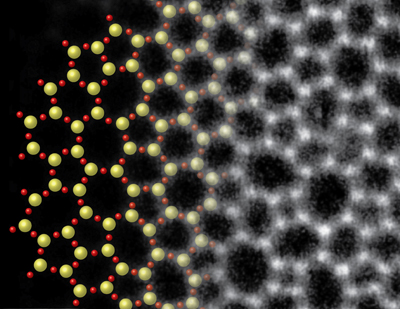
world's thinnest sheet of glass: one molecule thick

At just a molecule thick, it’s a new record: The world’s thinnest sheet of glass, a serendipitous discovery by scientists at Cornell and Germany’s University of Ulm, is recorded for posterity in the Guinness Book of World Records.

The “pane” of glass, so impossibly thin that its individual silicon and oxygen atoms are clearly visible via electron microscopy, was identified in the lab of David A. Muller, professor of applied and engineering physics and director of the Kavli Institute at Cornell for Nanoscale Science.

The work that describes direct imaging of this thin glass was published in January 2012 in Nano Letters, and the Guinness records officials took note. They published the achievement in early September for inclusion in the 2014 book, and the breakthrough is featured in the publication’s 21st Century Science spread.

Just two atoms in thickness, making it literally two-dimensional, the glass was an accidental discovery, Muller said. The scientists had been making graphene, a two-dimensional sheet of carbon atoms in a chicken wire crystal formation, on copper foils in a quartz furnace. They noticed some “muck” on the graphene, and upon further inspection, found it to be composed of the elements of everyday glass – silicon and oxygen.

Provided
An illustration shows a structural model, left, of 2-D glass, with electron microscopy data, right, of 2-D glass.

They concluded that an air leak had caused the copper to react with the quartz, also made of silicon and oxygen. This produced the glass layer on the would-be pure graphene.

Besides its sheer novelty, Muller continued, the work answers an 80-year-old question about the fundamental structure of glass. Scientists, with no way to directly see it, had struggled to understand it: It behaves like a solid but was thought to look more like a liquid.

Now, the Cornell scientists have produced a picture of individual atoms of glass, and they found it strikingly resembles a diagram drawn in 1932 by W.H. Zachariasen – a longstanding theoretical representation of the arrangement of atoms in glass.

“This is the work that, when I look back at my career, I will be most proud of,” Muller said. “It’s the first time that anyone has been able to see the arrangement of atoms in a glass.”

What’s more, two-dimensional glass could someday find a use in transistors, by providing a defect-free, ultra-thin material that could improve, for example, the performance of processors in computers and smartphones.

The paper, “Direct Imaging of a Two-Dimensional Silica Glass on Graphene,” was published in Nano Letters on Jan. 23, 2012, with first authors Pinshane Huang, a Cornell graduate student, and Simon Kurash, a University of Ulm graduate student. It includes collaborators from the University of Ulm, Germany; the Max Planck institute for Solid State Research in Germany; University of Vienna; University of Helsinki; and Aalto University in Finland.

The work at Cornell was funded by the National Science Foundation through the Cornell Center for Materials Research.


Thursday, September 5, 2013

Engineers make golden breakthrough to improve electronic devices based on molybdenum disulfide

A Kansas State University chemical engineer has discovered that a new member of the ultrathin materials family has great potential to improve electronic and thermal devices.
Vikas Berry, William H. Honstead professor of chemical engineering, and his research team have studied a new three-atom-thick material -- molybdenum disulfide -- and found that manipulating it with gold atoms improves its electrical characteristics. Their research appears in a recent issue of Nano Letters.
The research may advance transistors, photodetectors, sensors and thermally conductive coatings, Berry said. It could also produce ultrafast, ultrathin logic and plasmonics devices.
Berry's laboratory has been leading studies on synthesis and properties of several next-generation atomically thick nanomaterials, such as graphene and boron-nitride layers, which have been applied for sensitive detection, high-rectifying electronics, mechanically strong composites and novel bionanotechnology applications.
"Futuristically, these atomically thick structures have the potential to revolutionize electronics by evolving into devices that will be only a few atoms thick," Berry said.
For the latest research, Berry and his team focused on transistors based on molybdenum disulfide, or MoS2, which was isolated only two years ago. The material is made of three-atom-thick sheets and has recently shown to have transistor-rectification that is better than graphene, which is a single-atom-thick sheet of carbon atoms.
When Berry's team studied molybdenum disulfide's structure, they realized that the sulfur group on its surface had a strong chemistry with noble metals, including gold. By establishing a bond between molybdenum disulfide and gold nanostructures, they found that the bond acted as a highly coupled gate capacitor.
Berry's team enhanced several transistor characteristics of molybdenum disulfide by manipulating it with gold nanomaterials.
"The spontaneous, highly capacitive, lattice-driven and thermally-controlled interfacing of noble metals on metal-dichalcogenide layers can be employed to regulate their carrier concentration, pseudo-mobility, transport-barriers and phonon-transport for future devices," Berry said.
The work may greatly improve future electronics, which will be ultrathin, Berry said. The researchers have developed a way to reduce the power that is required to operate these ultrathin devices.
"The research will pave the way for atomically fusing layered heterostructures to leverage their capacitive interactions for next-generation electronics and photonics," Berry said. "For example, the gold nanoparticles can help launch 2-D plasmons on ultrathin materials, enabling their interference for plasmonic-logic devices."
The research also supports the current work on molybdenum disulfide-graphene-based electron-tunneling transistors by providing a route for direct electrode attachment on a molybdenum disulfide tunneling gate.
"The intimate, highly capacitive interaction of gold on molybdenum disulfide can induce enhanced pseudo-mobility and act as electrodes for heterostructure devices," said T.S. Sreeprasad, a postdoctoral researcher in Berry's group.
The researchers plan to create further complex nanoscale architectures on molybdenum disulfide to build logic devices and sensors.
"The incorporation of gold into molybdenum disulfide provides an avenue for transistors, biochemical sensors, plasmonic devices and catalytic substrate," said Phong Nguyen, a doctoral student in chemical engineering, Wichita, Kan., who is part of Berry's research team.
Namhoon Kim, master's student in grain science and industry, Korea,worked on the research as an undergraduate in chemical engineering.