Showing posts with label plasma. Show all posts

Tuesday, November 24, 2015

Electric Fields Remove Nanoparticles From Blood With Ease


Engineers at the University of California, San Diego developed a new technology that uses an oscillating electric field to easily and quickly isolate drug-delivery nanoparticles from blood. The technology could serve as a general tool to separate and recover nanoparticles from other complex fluids for medical, environmental, and industrial applications.

Nanoparticles, which are generally one thousand times smaller than the width of a human hair, are difficult to separate from plasma, the liquid component of blood, due to their small size and low density. Traditional methods to remove nanoparticles from plasma samples typically involve diluting the plasma, adding a high concentration sugar solution to the plasma and spinning it in a centrifuge, or attaching a targeting agent to the surface of the nanoparticles. These methods either alter the normal behavior of the nanoparticles or cannot be applied to some of the most common nanoparticle types.

“This is the first example of isolating a wide range of nanoparticles out of plasma with a minimum amount of manipulation,” said Stuart Ibsen, a postdoctoral fellow in the Department of NanoEngineering at UC San Diego and first author of the study published October in the journal Small. “We’ve designed a very versatile technique that can be used to recover nanoparticles in a lot of different processes.”

This new nanoparticle separation technology will enable researchers — particularly those who design and study drug-delivery nanoparticles for disease therapies — to better monitor what happens to nanoparticles circulating in a patient’s bloodstream. One of the questions that researchers face is how blood proteins bind to the surfaces of drug-delivery nanoparticles and make them less effective. Researchers could also use this technology in the clinic to determine if the blood chemistry of a particular patient is compatible with the surfaces of certain drug-delivery nanoparticles.

“We were interested in a fast and easy way to take these nanoparticles out of plasma so we could find out what’s going on at their surfaces and redesign them to work more effectively in blood,” said Michael Heller, a nanoengineering professor at the UC San Diego Jacobs School of Engineering and senior author of the study.

The device used to isolate the drug-delivery nanoparticles was a dime-sized electric chip manufactured by La Jolla-based Biological Dynamics, which licensed the original technology from UC San Diego. The chip contains hundreds of tiny electrodes that generate a rapidly oscillating electric field that selectively pulls the nanoparticles out of a plasma sample. Researchers inserted a drop of plasma spiked with nanoparticles into the electric chip and demonstrated nanoparticle recovery within 7 minutes. The technology worked on different types of drug-delivery nanoparticles that are typically studied in various labs.

The breakthrough in the technology relies on designing a chip that can work in the high salt concentration of blood plasma. The chip’s ability to pull the nanoparticles out of plasma is based on differences in the material properties between the nanoparticles and plasma components.

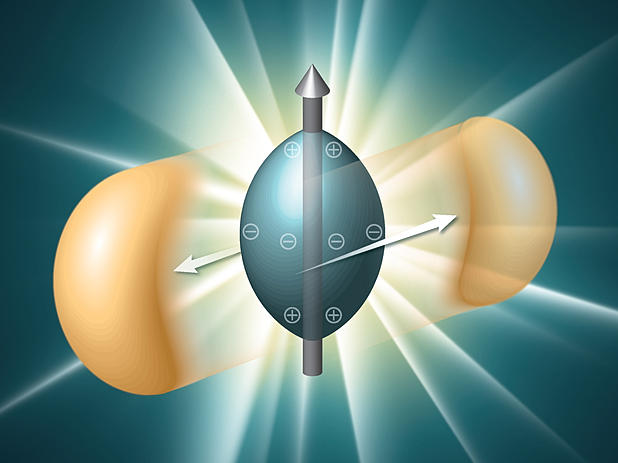
When the chip’s electrodes apply an oscillating electric field, the positive and negative charges inside the nanoparticles reorient themselves at a different speed than the charges in the surrounding plasma. This momentary imbalance in the charges creates an attractive force between the nanoparticles and the electrodes. As the electric field oscillates, the nanoparticles are continually pulled towards the electrodes, leaving the rest of the plasma behind. Also, the electric field is designed to oscillate at just the right frequency: 15,000 times per second.
“It’s amazing that this method works without any modifications to the plasma samples or to the nanoparticles,” said Ibsen.

Friday, June 12, 2015

Controlling energy flow and loss in a turbulent plasma through helicity


Fresh theoretical understanding of the behaviour of turbulent plasmas could inform potential applications, from tokamak fusion reactors to new understanding of magnetic fields in cosmology. Researchers at the School of Physics & Astronomy have developed a new mathematical description of the energy flow of a turbulent plasma, and how the loss of energy from a plasma can be controlled.

The study, led by Prof. Arjun Berera and PhD student Moritz Linkmann using the ARCHER(link is external)supercomputer, has led to the first simplified formula to quantify these effects in plasmas affected by magnetic fields. The work also offers new insights into energy flows between fluids and magnetic systems, aiding understanding of how magnetic energy can grow at large scales in a plasma. 
 
Novel insights into turbulent plasma
 
Recent work at the School of Physics and Astronomy has added novel insights into how the growth, flow and decay of energy in a turbulent plasma can be controlled by the plasma viscosity, the state of magnetic helicity (internal angular momentum and degree of tangledness of the magnetic field) and the state of cross helicity (correlation between the magnetic field fluctuations and the fluctuations of kinetic energy inherent in a turbulent plasma).

A new formula is obtained for understanding the flow of energy out of, and therefore the energy maintained in, a turbulent plasma, which depends on the state of magnetic and cross helicities contained in the magnetic field-fluid system. These results, obtained by a combination of theoretical work and numerical simulations using the ARCHER supercomputer, show how this energy flow can be controlled, leading to the first simplified formula to quantify these effects in magnetofluids. Understanding has also been obtained in how energy flows between the fluid and the magnetic field, adding new insights on how magnetic energy can grow at large length scales in a turbulent magnetofluid. These theoretical results are fundamental steps towards potential practical applications in areas as varied as controlling the plasma in a tokamak fusion reactor and understanding the presence and growth of magnetic fields in galaxies, galaxy clusters and even at the scale of the entire Universe.

This work has come out in a Physical Review Letter and an earlier Physical Review E Rapid Communication. Both figures below contain results from the two publications, all obtained from medium to high resolution simulations carried out on ARCHER.

"Results shown in Fig.1 extend the accuracy and extent of detail from previous results in the literature, while results shown in Fig. 2 had been anticipated in terms of qualitative expectations but were never studied systematically before. Their papers have in turn proposed a new way of looking at the problem and by doing so obtained a simple expression derived from the underlying equations that can predict and explain the behaviour seen in these figures, which is the main significant new advance from this work. Their systematic studies have been made possible to a large extent through access to ARCHER, which enabled them to probe a significant section of parameter space.
It has been known for some time that certain correlations between the velocity and magnetic vector fields alter the dynamics of turbulent magnetofluids. What is new from our work is it predicts with a simple expression how the flow of energy out of a turbulent plasma can be controlled based on the viscosity and state of angular momemtum in the magnetic-fluid system. This is a fundamental step toward potential practical applications in areas as varied as controlling the plasma in a tokamak fusion reactor, understanding the presence and growth of magnetic fields in galaxies, galaxy clusters and even at the scale of the entire Universe.'' Arjun Berera

"Much work still needs to be done before quantitative theoretical predictions can be made. Our results are fundamental in the sense that they apply to turbulent magnetofluids far from the boundaries of a containing vessel. Therefore this does not give the full details for specific geometries, such as of a fusion reactor, but our results describe the general behaviour of evolution of the plasma far away from any boundaries, thus are of general applicability to a range of plasmas systems.'' Moritz Linkmann

Source: http://www.nanotechnologyworld.org/#!Controlling-energy-flow-and-loss-in-a-turbulent-plasma-through-helicity/c89r/557ad8f10cf208e6a4df1ff3 

Monday, June 8, 2015

Scientists See Ripples of a Particle-Separating Wave In Primordial Plasma


Key sign of quark-gluon plasma (QGP) and evidence for a long-debated quantum phenomenon
 
Scientists in the STAR collaboration at the Relativistic Heavy Ion Collider (RHIC), a particle accelerator exploring nuclear physics and the building blocks of matter at the U.S. Department of Energy’s Brookhaven National Laboratory, have new evidence for what’s called a “chiral magnetic wave” rippling through the soup of quark-gluon plasma created in RHIC’s energetic particle smashups. 

The presence of this wave is one of the consequences scientists were expecting to observe in the quark-gluon plasma—a state of matter that existed in the early universe when quarks and gluons, the building blocks of protons and neutrons, were free before becoming inextricably bound within those larger particles. The tentative discovery, if confirmed, would provide additional evidence that RHIC’s collisions of energetic gold ions recreate nucleus-size blobs of the fiery plasma thousands of times each second. It would also provide circumstantial evidence in support of a separate, long-debated quantum phenomenon required for the wave’s existence. The findings are described in a paper that will be highlighted as an Editors' Suggestion in Physical Review Letters.

To try to understand these results, let’s take a look deep within the plasma to a seemingly surreal world where magnetic fields separate left- and right-“handed” particles, setting up waves that have differing effects on how negatively and positively charged particles flow.

The presence of this wave is one of the consequences scientists were expecting to observe in the quark-gluon plasma. It also provides circumstantial evidence for a separate, long-debated quantum phenomenon.
“What we measure in our detector is the tendency of negatively charged particles to come out of the collisions around the ‘equator’ of the fireball, while positively charged particles are pushed to the poles,” said STAR collaborator Hongwei Ke, a postdoctoral fellow at Brookhaven. But the reasons for this differential flow, he explained, begin when the gold ions collide. 

The ions are gold atoms stripped of their electrons, leaving 79 positively charged protons in a naked nucleus. When these ions smash into one another even slightly off center, the whole mix of charged matter starts to swirl. That swirling positive charge sets up a powerful magnetic field perpendicular to the circulating mass of matter, Ke explained. Picture a spinning sphere with north and south poles. 

Within that swirling mass, there are huge numbers of subatomic particles, including quarks and gluons at the early stage, and other particles at a later stage, created by the energy deposited in the collision zone. Many of those particles also spin as they move through the magnetic field. The direction of their spin relative to their direction of motion is a property called chirality, or handedness; a particle moving away from you spinning clockwise would be right-handed, while one spinning counterclockwise would be left-handed. 


The STAR detector at RHIC tracks particles emerging from thousands of subatomic smashups per second.

According to Gang Wang, a STAR collaborator from the University of California at Los Angeles, if the numbers of particles and antiparticles are different, the magnetic field will affect these left- and right-handed particles differently, causing them to separate along the axis of the magnetic field according to their “chiral charge.” 

“This ‘chiral separation’ acts like a seed that, in turn, causes particles with different charges to separate,” Gang said. “That triggers even more chiral separation, and more charge separation, and so on—with the two effects building on one another like a wave, hence the name ‘chiral magnetic wave.’ In the end, what you see is that these two effects together will push more negative particles into the equator and the positive particles to the poles.”

To look for this effect, the STAR scientists measured the collective motion of certain positively and negatively charged particles produced in RHIC collisions. They found that the collective elliptic flow of the negatively charged particles—their tendency to flow out along the equator—was enhanced, while the elliptic flow of the positive particles was suppressed, resulting in a higher abundance of positive particles at the poles. Importantly, the difference in elliptic flow between positive and negative particles increased with the net charge density produced in RHIC collisions.

According to the STAR publication, this is exactly what is expected from calculations using the theory predicting the existence of the chiral magnetic wave. The authors note that the results hold out for all energies at which a quark-gluon plasma is believed to be created at RHIC, and that, so far, no other model can explain them.

The finding, says Aihong Tang, a STAR physicist from Brookhaven Lab, has a few important implications.
“First, seeing evidence for the chiral magnetic wave means the elements required to create the wave must also exist in the quark-gluon plasma. One of these is the chiral magnetic effect—the quantum physics phenomenon that causes the electric charge separation along the axis of the magnetic field—which has been a hotly debated topic in physics. Evidence of the wave is evidence that the chiral magnetic effect also exists.” Tang said.

The chiral magnetic effect is also related to another intriguing observation at RHIC of more-localized charge separation within the quark-gluon plasma. So this new evidence of the wave provides circumstantial support for those earlier findings.

Finally, Tang pointed out that the process resulting in propagation of the chiral magnetic wave requires that “chiral symmetry”—the independent identities of left- and right-handed particles—be “restored.” 
“In the ‘ground state’ of quantum chromodynamics (QCD)—the theory that describes the fundamental interactions of quarks and gluons—chiral symmetry is broken, and left- and right-handed particles can transform into one another. So the chiral charge would be eliminated and you wouldn’t see the propagation of the chiral magnetic wave,” said nuclear theorist Dmitri Kharzeev, a physicist at Brookhaven and Stony Brook University. But QCD predicts that when quarks and gluons are deconfined, or set free from protons and neutrons as in a quark-gluon plasma, chiral symmetry is restored. So the observation of the chiral wave provides evidence for chiral symmetry restoration—a key signature that quark-gluon plasma has been created.

“How does deconfinement restore the symmetry? This is one of the main things we want to solve,” Kharzeev said. “We know from the numerical studies of QCD that deconfinement and restoration happen together, which suggests there is some deep relationship. We really want to understand that connection.” 

Brookhaven physicist Zhangbu Xu, spokesperson for the STAR collaboration, added, “To improve our ability to search for and understand the chiral effects, we’d like to compare collisions of nuclei that have the same mass number but different numbers of protons—and therefore, different amounts of positive charge (for example, Ruthenium, mass number 96 with 44 protons, and Zirconium, mass number 96 with 40 protons). That would allow us to vary the strength of the initial magnetic field while keeping all other conditions essentially the same.”
Research at RHIC, a DOE Office of Science User Facility, is supported by the Office of Science (NP) and these agencies and organizations.

Brookhaven National Laboratory is supported by the Office of Science of the U.S. Department of Energy.  The Office of Science is the single largest supporter of basic research in the physical sciences in the United States, and is working to address some of the most pressing challenges of our time.  For more information, please visit science.energy.gov.

Source: http://www.nanotechnologyworld.org/#!Scientists-See-Ripples-of-a-ParticleSeparating-Wave-In-Primordial-Plasma/c89r/557596ec0cf2e4994fb7bcef