Showing posts with label Quantum Dots. Show all posts

Wednesday, December 16, 2015

The tiniest color picture ever printed


Researchers of ETH Zurich and ETH start-up company Scrona achieve a new world record! They have printed a color picture depicting clown fishes around their sea anemone home. This picture is as tiny as the cross-sectional area of a human hair.

As of today Scrona Ltd. and the ETH Zurich have been announced official World Record Holders for the smallest inkjet-printed colour image. TheGuinness World Records Limited achievement involved the use of the groundbreaking 3D NanoDrip printing technology, invented at ETH Zurich and now commercialized by the ETH spin-off company Scrona.

The printed image measures a minuscule 0.0092 mm2 in area, or 80 µm x 115 µm. That’s about the cross-sectional area of a human hair or the area covered by a single pixel of a retina display. Being so small, the image is totally invisible to the naked eye. To see it, the official witnesses had to use a special microscope.


Miniaturized clown fishes


The printed image represents a scenery of clown fishes around sea anemones. The colorful little fishes that grow to a size of just about 10 cm (3.9 in.) in real life have been shrunk to approximately 30 µm (0.001 in.). But the fishes do not seem to feel any discomfort in their 3’333-fold miniaturization. Thanks to 24bit color depth in the printout the picturesque scene that depicts their home appears almost as colorful as in reality.

What makes the image appear so lively is the result of so-called quantum-dots (QDs). QDs are nanoparticles that emit light of a very specific color. By tuning their size, this color can be freely engineered, for example from orange to yellow. QDs are known to be very intense in their color appearance, a reason why they currently make a strong debut in flat panel displays.

To create the clown fishes and their cozy sea anemone homes, layers of red, green and blue quantum dots were printed at a resolution of 25’000 DPI, i.e. at an inter-pixel distance of 500 nanometers. To define the 24bit color space the thickness of the deposited quantum dot layers had to be controlled with incredible sub-nanometer precision, at each pixel location.


New avenues in display sector


Until now, even with cutting-edge semiconductor technology, it was not possible to handle these nanostructured materials with the incredible accuracy that is demonstrated by this Guinness World Records Ltd. achievement. Therefore, the image printed by Scrona and ETH Zurich is not only nice to look at. It highlights new avenues towards the use of nanostructured materials in future electronics and optics, particularly in the display sector.

But before hitting industry, Scrona is now providing a unique opportunity for everyone to experience the technology. Via Kickstarter they offer copies of the true-to-life micro-image, but instead of clown fishes they print the personal content provided by the buyers. In the package is also contained a powerful miniature microscope that is used to render the microscopic pictures visible. This offer is open until 9th of January when their campaign ends.

Thursday, May 22, 2014

Resonant Energy Transfer from Quantum Dots to Graphene

Schematic of a quantum dot-graphene nano-photonic device,
as described in this research project.
Semiconductor quantum dots (QDs) are nanoscale semiconductors that exhibit size dependent physical properties. For example, the color (wavelength) of light that they absorb changes dramatically as the diameter decreases. 
Graphene is an atomically thick sheet of carbon atoms, arranged in a hexagonal lattice pattern. In this work, QDs have been combined with graphene to develop nanoscale photonic devices that can dramatically improve our ability to detect light. Quantum dots can absorb light and transfer it to graphene, but the efficiency of the transfer depends on how far the QDs and the graphene are separated from each other. 
This study demonstrated that the thickness of the organic molecule layer that typically surrounds the QDs is crucial in attaining sufficiently high efficiency of this light/energy transfer into the graphene. In other works, the thinner the organic layer, the better. This transfer can be further optimized by engineering the interface between the two nanomaterials, specifically optimizing the thickness of the organic capping molecules on the quantum dots. Based on this work, further improvement of the performance of these nano-photonic devices can be expected.

Why Does This Matter?

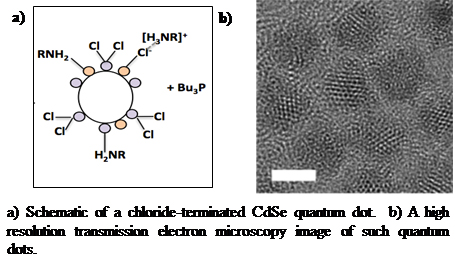
chloride-terminated CdSe quantum dot
a) Schematic of a chloride-terminated CdSe quantum dot. b) A high resolution transmission electron microscopy image of such quantum dots.
Commercial cadmium selenide (CdSe) quantum dots have long insulating organic ligands that prevent their utilization in energy and charge transfer applications for which short distances between the QDs and other materials are critical.  Short, chlorine ligands that passivated CdSe QDs are an intriguing alternative material to enhance the interaction with materials into which charge carriers, such as electrons, can easily conduct.  Graphene is such a material.  The combination of CdSe quantum dots and graphene could hold the key to the development and implementation of nanoscale materials systems in flexible electronics and photodetectors.
Photoluminescence lifetime decay of isolated quantum dots
Photoluminescence lifetime decay of isolated quantum dots on glass (blue) and graphene (red) demonstrate efficient energy transfer between the quantum dots and graphene.

What Are The Details?

  • CFN Capabilities: The Advanced Optical Microscopy Facility measured the time-resolved photoluminescence from isolated CdSe quantum dots deposited on graphene.
  • The team discovered that short, chloride-capped CdSe quantum dots, deposited on chemical-vapor-deposited, monolayer layer graphene, exhibited highly efficient energy transfer to the graphene with a 4x observed reduction in the excitonic lifetime.  This demonstrated significant near-field coupling between quantum dots and the graphene.  

http://www.bnl.gov/newsroom/news.php?a=24906

Tuesday, April 8, 2014

Nanodot bio-organic nanochrystals will charge you phone in 30 seconds flat… in 2016


An Israeli technology company is working on a technology that could transform the semiconductor and energy-storage business. If you transform those industries, you transform modern life.

Store Dot, based in Ramat Gan, just to the west of Tel Aviv, is creating biological semiconductors that can, among other things, store a charge, emit visible light and be used to produce high-capacity, or quick-charging, batteries.

“If everything works, and we have a lot of evidence that it will do, we have a revolution in many devices—memory, batteries, the display, image sensors,” said Doron Myersdorf, chief executive of Store Dot.

The semiconductors are known as quantum dots and are made from naturally occurring organic compounds called peptides, short chains of amino acids, the building blocks of proteins. According to Gil Rosenman, chief scientist of Store Dot and holder of the Henry and Dinah Krongold Chair of Microelectronics at Tel Aviv University, when the company manipulates their chemistry, these peptides can be made to self-assemble into quantum dots—molecular-size materials that have remarkable properties.

“We take these peptides, manipulate them and manage the self-assembly process that usually takes place in nature,” said Mr. Myersdorf. “Only two molecules of peptide attach to each other, and they create a very little structure, two nanometers in size. It has very interesting properties—some are optical, some are related to charge, and others piezoelectric,” meaning they generate charge under mechanical strain.

To get some idea of the scale, the diameter of a human immunodeficiency virus is about 60 times as large.

According to Mr. Myersdorf, these peptide-based quantum dots are crystalline in nature. “That is important,” he said. “It means they are stable. They can also hold a charge. That means we can actually create a memory.”

Quantum dots are not new, but typically they have been made using inorganic materials such as cadmium selenide. a known carcinogen. Further, he said, because it is a physical manufacturing process, there tend to be large discrepancies in the size of dots produced. Using a natural, organic process creates dots that are cheaper and less environmentally damaging to produce, and the results have high levels of purity and are identical in size. “We let nature take its course.”

Inorganic quantum dots already are being used for displays, and previously it was thought that organic dots would only radiate in ultraviolet frequencies. However, by manipulating the chemistry of the dots, Mr. Rosenman has been able to get them to generate colored light. “No one knows these peptides can be caused to vibrate in the visible spectrum,” he said.

Although the technology has a wide range of applications, and Store Dot has protected intellectual property in many areas, it is, for now at least, concentrating on just two: displays and batteries.

In a demonstration, Mr. Rosenman shone a blue light (the backlight in an LCD TV is blue) onto tubes containing different solutions of quantum dots. The tubes lit up in red, green and blue—the constituents of any display. “There is a cost saving of about 10 times compared to other displays,” said Mr. Myersdorf. “The manufacturing process is the same as for making OLEDs.” An OLED is an organic light-emitting diode, commonly found in some smartphones and TVs.

But it isn’t just far-cheaper displays that Store Dot is working on. Mr. Rosenman demonstrated a power cell. By replacing the electrolyte with a solution containing the quantum dots, the same cell had a five-fold increase in charge.

Not only can much more powerful batteries be made (or batteries generating the same power at a greatly reduced size), but quantum-dot-enhanced power cells should not show the same degradation as conventional batteries.

“Because the quantum dots are crystalline, they stay for thousands of charge cycles,” Mr. Rosenman said.

The company is working on a cell for powering a cellphone that would take just seven minutes to charge for daily use.

At the moment the technology is still in the laboratory, but Store Dot is moving to trials and is in talks with cellphone maker Samsung Electronics Co. and others about commercializing the technology.

Monday, February 3, 2014

Quantum dots provide complete control of photons

By emitting photons from a quantum dot at the top of a micropyramid, researchers at Linköping University are creating a polarized light source for such things as energy-saving computer screens and wiretap-proof communications.

Polarized light – where all the light waves oscillate on the same plane – forms the foundation for technology such as LCD displays in computers and TV sets, and advanced quantum encryption. Normally, this is created by normal unpolarized light passing through a filter that blocks the unwanted light waves. At least half of the light emitted, and thereby an equal amount of energy, is lost in the process.
A better method is to emit light that is polarized right at the source. This can be achieved with quantum dots – crystals of semiconductive material so small that they produce quantum mechanical phenomena. But until now, they have only achieved polarization that is either entirely too weak or hard to control.
A semiconductive materials research group led by Professor Per Olof Holtz is now presenting an alternative method where asymmetrical quantum dots of a nitride material with indium is formed at the top of microscopic six-sided pyramids. With these, they have succeeded in creating light with a high degree of linear polarization, on average 84%. The results are being published in the Nature periodical Light: Science & Applications.
“We’re demonstrating a new way to generate polarized light directly, with a predetermined polarization vector and with a degree of polarization substantially higher than with the methods previously launched,” Professor Holtz says.
In experiments, quantum dots were used that emit violet light with a wavelength of 415 nm, but the photons can in principle take on any colour at all within the visible spectrum through varying the amount of the metal indium.
“Our theoretical calculations point to the fact that an increased amount of indium in the quantum dots further improves the degree of polarization,” says reader Fredrik Karlsson, one of the authors of the article.
The micropyramid is constructed through crystalline growth, atom layer by atom layer, of the semiconductive material gallium nitride. A couple of nanothin layers where the metal indium is also included are laid on top of this. From the asymmetrical quantum dot thus formed at the top, light particles are emitted with a well-defined wavelength.
The results of the research are opening up possibilities, for example for more energy-effective polarized light-emitting diodes in the light source for LCD screens. As the quantum dots can also emit one photon at a time, this is very promising technology for quantum encryption, a growing technology for wiretap-proof communications.
Image: Two ways of creating polarized light. Fredrik Karlsson, LiU.

Article: Direct generation of linearly polarized photon emission with designated orientations from site-controlled InGaN quantum dots by A. Lundskog, C-W Hsu, K F Karlsson, S Amloy, D Nilsson, U Forsberg, P O Holtz and E Janzén. Light: Science & Applications (2014) 3, e139; online 31 January 2014. doi:10.1038/lsa.2014.20
Contact:
Per Olof Holtz, professor, 013-28 26 28, poh@ifm.liu.se
The project has been conducted within Nano-N consortium funded by the Swedish Foundation for Strategic Research.

Source: http://www.liu.se/forskning/forskningsnyheter/1.541547?l=en

Monday, January 27, 2014

Solotronics: New quantum dots herald a new era of electronics operating on a single-atom level

New types of solotronic structures, including the world’s first quantum dots containing single cobalt ions, have been created and studied at the Faculty of Physics at the University of Warsaw. The materials and elements used to form these structures allow us forecast new trends in solotronics – a field of experimental electronics and spintronics of the future, based on operations occurring on a single-atom level.
Electronic systems operating on the level of individual atoms would seem to be the natural consequence of efforts to achieve ever-greater miniaturization. Already now, we are able to control the behavior of individual atoms by situating them within special semiconductor structures – this is the method used to form quantum dots that contain single magnetic ions. Until recently, only two variants of such structures were known. However, physicists from the Institute of Experimental Physics at the Faculty of Physics at the University of Warsaw (FUW) have successfully created and studied two completely new types of the structures. The materials and elements used in the process make it wholly likely that solotronic devices may come into widespread use in the future.
The results, the Warsaw physicists have just published in Nature Communications, pave the way for developing the field of solotronics.
“Quantum dots are semiconductor crystals on a nanometer scale. They are so tiny that the electrons within them exist only in states with specific energies. As such, quantum dots exhibit similar characteristics to atoms, and – just like atoms – they can be stimulated with light to reach higher energy levels. Conversely, this means they emit light as they return to states with lower energy levels,” says Prof. Piotr Kossacki (FUW).
The University laboratory creates quantum dots using molecular beam epitaxy. The process involves precision-heating crucibles containing elements placed in a vacuum chamber. Beams of elements are deposited on the sample. By carefully selecting materials and experimental conditions, the atoms assemble into tiny islands, known as quantum dots. The process is similar to how water vapor condenses on a hydrophobic surface.
While the dots settle, a small quantity of other atoms (for example magnetic ones) can be introduced into the vacuum chamber, with some becoming a part of the emerging dots. Once the sample is removed, it can be examined under a microscope to detect quantum dots containing a single magnetic atom at the center.
“Atoms with magnetic properties disrupt the energy levels of electrons in a quantum dot, which affects how they interact with light. As a result, the quantum dot becomes a detector of such an atom’s state. The relationship also works the other way: by changing energy states of electrons in quantum dots, we can affect the respective magnetic atoms,” explains Michał Papaj, a student at the UW Faculty of Physics, awarded the Gold Medal in Chemistry during last year’s national competition for the best B.Sc. thesis held by the Institute of Physical Chemistry of the Polish Academy of Sciences for his work on quantum dots containing single cobalt ions.
The most powerful magnetic properties are observed in manganese atoms stripped of two electrons (Mn2+). In experiments conducted thus far, the ions have been mounted in quantum dots made of cadmium telluride (CdTe) or indium arsenide (InAs). Using CdTe dots prepared by Dr. Piotr Wojnar at the PAS Institute of Physics, in 2009 Mateusz Goryca from the University of Warsaw demonstrated the first magnetic memory operating on a single magnetic ion.
“It was commonly believed that other magnetic ions, such as cobalt (Co2+), cannot be used in quantum dots. We decided to verify this, and nature gave us a pleasant surprise: the presence of a new magnetic ion turned out not to destroy the properties of the quantum dot,” says Jakub Kobak, doctoral student at the University of Warsaw.
Researchers from the University of Warsaw have presented two new systems with single magnetic ions: CdTe quantum dots with a cobalt atom, and cadmium selenide (CdSe) dots with a manganese atom.
As already stated, manganese atoms exhibit the most powerful magnetic properties. Unfortunately, they are caused by the atomic nucleus as well as the electrons, which means that quantum dots containing manganese ions are complex quantum systems. The discovery made by physicists at the University of Warsaw demonstrates that other magnetic elements – such as chromium, iron and nickel – can be used in place of manganese. These elements do not have nuclear spin, which should make quantum dots that contain them easier to manipulate.
In quantum dots where tellurium is replaced by the lighter selenium, researchers observed that the duration for which information was remembered increased by an order of magnitude. This finding suggests that using lighter elements should prolong the time quantum dots containing single magnetic ions store information, perhaps even by several orders of magnitude.
“We have demonstrated that two quantum systems that were believed not to be viable in fact worked very effectively. This opens up a broad field in our search for other, previously rejected combinations of materials for quantum dots and magnetic ions,” concludes Dr. Wojciech Pacuski (FUW).
The research into quantum dots containing single magnetic ions was funded with grants from the Polish National Science Centre and the Polish National Centre for Research and Development, as well as project funds from the Centre for Preclinical Research and Technology.

Source: http://www.fuw.edu.pl/press-release/news2556.html

Friday, October 4, 2013

Which makes a better solar collector, quantum dot or nanowire

A trio of researchers at North Dakota State University, Fargo and the University of South Dakota have turned to computer modeling to help decide which of two competing materials should get its day in the sun as the nanoscale energy-harvesting technology of future solar panels - quantum dots or nanowires.
 
Andrei Kryjevski and his colleagues, Dimitri Kilin and Svetlana Kilina, report in AIP Publishing's Journal of Renewable and Sustainable Energy that they used computational chemistry models to predict the electronic and optical properties of three types of nanoscale (billionth of a meter) silicon structures with a potential application for solar energy collection: a quantum dot, one-dimensional chains of quantum dots and a nanowire. The ability to absorb light is substantially enhanced in nanomaterials compared to those used in conventional semiconductors. Determining which form - quantum dots or nanowire -maximizes this advantage was the goal of the numerical experiment conducted by the three researchers.
 
"We used Density Functional Theory, a computational approach that allows us to predict electronic and optical properties that reflect how well the nanoparticles can absorb light, and how that effectiveness is affected by the interaction between quantum dots and the disorder in their structures," Kryjevski said. "This way, we can predict how quantum dots, quantum dot chains and nanowires will behave in real life even before they are synthesized and their working properties experimentally checked."
 
The simulations made by Kryjevski, Kilin and Kilina indicated that light absorption by silicon quantum dot chains significantly increases with increased interactions between the individual nanospheres in the chain. They also found that light absorption by quantum dot chains and nanowires depends strongly on how the structure is aligned in relation to the direction of the photons striking it. Finally, the researchers learned that the atomic structure disorder in the amorphous nanoparticles results in better light absorption at lower energies compared to crystalline-based nanomaterials.
 
"Based on our findings, we believe that putting the amorphous quantum dots in an array or merging them into a nanowire are the best assemblies for maximizing the efficiency of silicon nanomaterials to absorb light and transport charge throughout a photovoltaic system," Kryjevski said. "However, our study is only a first step in a comprehensive computational investigation of the properties of semiconductor quantum dot assemblies.The next steps are to build more realistic models, such as larger quantum dots with their surfaces covered by organic ligands and simulate the processes that occur in actual solar cells," he added.
 
Source and top image: American Institute of Physics
Top image shows: Amorphous Silicon nanowire (yellow network) facilitates harvesting of solar energy in the form of a photon (wavy line). In the process of light absorption a pair of mobile charge carriers is created (red clouds depict an electron smeared in space, while the blue clouds visualize the so-called hole which is a positively charged carrier). The energy of their directed motion is then transformed into electricity. Electron and hole charge distributions are often located in different regions of space due to multiple structural defects in amorphous silicon nanowires.


Friday, September 13, 2013

NRL Achieves Highest Open-Circuit Voltage for Quantum Dot Solar Cells

Schematic of metal-lead sulfide quantum dot Schottky junction
solar cells (glass/ITO/PbS QDs/LiF/Al). Novel Schottky junction
solar cells developed at NRL are capable of achieving
the highest open-circuit voltages ever reported for colloidal
QD based solar cells. 

(Photo: U.S. Naval Research Laboratory) 
U.S. Naval Research Laboratory (NRL) research scientists and engineers in the Electronics Science and Technology Division have demonstrated the highest recorded open-circuit voltages for quantum dot solar cells to date. Using colloidal lead sulfide (PbS) nanocrystal quantum dot (QD) substances, researchers achieved an open-circuit voltage (VOC) of 692 millivolts (mV) using the QD bandgap of a 1.4 electron volt (eV) in QD solar cell under one-sun illumination. 

"These results clearly demonstrate that there is a tremendous opportunity for improvement of open-circuit voltages greater than one volt by using smaller QDs in QD solar cells," said Woojun Yoon, Ph.D., NRC postdoctoral researcher, NRL Solid State Devices Branch. "Solution processability coupled with the potential for multiple exciton generation processes make nanocrystal quantum dots promising candidates for third generation low-cost and high-efficiency photovoltaics."

Despite this remarkable potential for high photocurrent generation, the achievable open-circuit voltage is fundamentally limited due to non-radiative recombination processes in QD solar cells. To overcome this boundary, NRL researchers have reengineered molecular passivation in metal-QD Schottky junction (unidirectional metal to semiconductor junction) solar cells capable of achieving the highest open-circuit voltages ever reported for colloidal QD based solar cells.

Experimental results demonstrate that by improving the passivation of the PbS QD surface through tailored annealing of QD and metal-QD interface using lithium fluoride (LiF) passivation with an optimized LiF thickness. This proves critical for reducing dark current densities by passivating localized traps in the PbS QD surface and metal-QD interface close to the junction, therefore minimizing non-radiative recombination processes in the cells.

Over the last decade, Department of Defense (DoD) analyses and the department's recent FY12 Strategic Sustainability Performance Plan, has cited the military's fossil fuel dependence as a strategic risk and identified renewable energy and energy efficiency investments as key mitigation measures. Research at NRL is committed to supporting the goals and mission of the DoD by providing basic and applied research toward mission-ready renewable and sustainable energy technologies that include hybrid fuels and fuel cells, photovoltaics, and carbon-neutral biological microorganisms.

Source: http://www.nrl.navy.mil/media/news-releases/2013/nrl-achieves-highest-open-circuit-voltage-for-quantum-dot-solar-cells#sthash.8luqmdmj.dpuf

Wednesday, September 4, 2013

Breakthrough in sensing at the nanoscale

Researchers have made a breakthrough discovery in identifying the world's most sensitive nanoparticle and measuring it from a distance using light. These super-bright, photostable and background-free nanocrystals enable a new approach to highly advanced sensing technologies using optical fibres.
This discovery, by a team of researchers from Macquarie University, the University of Adelaide, and Peking University, opens the way for rapid localisation and measurement of cells within a living environment at the nanoscale, such as the changes to a single living cell in the human body in response to chemical signals.
Published in Nature Nanotechnology today, the research outlines a new approach to advanced sensing that has been facilitated by bringing together a specific form of nanocrystal, or "SuperDotTM" with a special kind of optical fibre that enables light to interact with tiny (nanoscale) volumes of liquid.
"Up until now, measuring a single nanoparticle would have required placing it inside a very bulky and expensive microscope," says Professor Tanya Monro, Director of the University of Adelaide's Institute for Photonics and Advanced Sensing (IPAS) and ARC Australian Laureate Fellow. "For the first time, we've been able to detect a single nanoparticle at one end of an optical fibre from the other end. That opens up all sorts of possibilities in sensing."
"Using optical fibres we can get to many places such as inside the living human brain, next to a developing embryo, or within an artery - locations that are inaccessible to conventional measurement tools.
"This advance ultimately paves the way to breakthroughs in medical treatment. For example, measuring a cell's reaction in real time to a cancer drug means doctors could tell at the time treatment is being delivered whether or not a person is responding to the therapy."
The performance of sensing at single molecular level had previously been limited by both insufficient signal strength and interference from background noise. The special optical fibre engineered at IPAS also proved useful in understanding the properties of nanoparticles. "Material scientists have faced a huge challenge in increasing the brightness of nanocrystals," says Dr. Jin, ARC Fellow at Macquarie University's Advanced Cytometry Laboratories. "Using these optical fibres, however, we have been given unprecedented insight into the light emissions. Now, thousands of emitters can be incorporated into a single SuperDotTM - creating a far brighter, and more easily detectable nanocrystal."
Under infrared illumination, these SuperDotsTM selectively produce bright blue, red and infrared light, with a staggering thousand times more sensitivity than existing materials. "Neither the glass of the optical fibre nor other background biological molecules respond to infrared, so that removed the background signal issue. By exciting these SuperDotsTM we were able to lower the detection limit to the ultimate level - a single nanoparticle," says Jin.
"The trans-disciplinary research from multiple institutions has paved the way for this innovative discovery," says Jin, "with the interface of experts in nanomaterials, photonics engineering, and biomolecular frontiers."
"These joint efforts will ultimately benefit patients around the world - for example, our industry partners Minomic International Ltd and Patrys Ltd are developing uses for SuperDotsTMin cancer diagnostic kits, detecting incredibly low numbers of biomarkers within conditions like prostate and multiple myeloma cancer."
Macquarie is now actively seeking other industrial partners with the capacity to jointly develop solutions outside of these fields.

http://www.adelaide.edu.au/news/news64302.html

Monday, August 26, 2013

New nanomaterial increases yield of solar cells

Researchers from the FOM Foundation, Delft University of Technology, Toyota Motor Europe and the University of California have developed a nanostructure with which they can make solar cells highly efficient. The researchers published their findings on 23 August 2013 in the online edition of Nature Communications. 

Smart nanostructures can increase the yield of solar cells. An international team of researchers including physicists from the FOM Foundation, Delft University of Technology and Toyota, have now optimised the nanostructures so that the solar cell provides more electricity and loses less energy in the form of heat.

Solar cells

A conventional solar cell contains a layer of silicon. When sunlight falls on this layer, electrons in the silicon absorb the energy of the light particles (photons). Using this energy the electrons jump across a 'band gap', as a result of which they can freely move and electricity flows.
The yield of a solar cell is optimised if the photon energy is equal to the band gap of silicon. Sunlight, however, contains many photons with energies greater than the band gap. The excess energy is lost as heat, which limits the yield of a conventional solar cell.

Nanospheres

Several years ago the researchers from Delft University of Technology, as well as other physicists, demonstrated that the excess energy could still be put to good use. In small spheres of a semiconducting material the excess energy enables extra electrons to jump across the band gap. These nanospheres, the so-called quantum dots, have a diameter of just one ten thousandth of a human hair.
If a light particle enables an electron in a quantum dot to cross the band gap, the electron moves around in the dot. That ensures that the electron collides with other electrons that subsequently jump across the band gap as well. As a result of this process a single photon can mobilise several electrons thereby multiplying the amount of current produced.

Contact between quantum dots

However, up until now the problem was that the electrons remained trapped in their quantum dots and so could not contribute to the current in the solar cell. That was due to the large molecules that stabilise the surface of quantum dots. These large molecules hinder the electrons jumping from one quantum dot to the next and so no current flows.
In the new design, the researchers replaced the large molecules with small molecules and filled the empty space between the quantum dots with aluminium oxide. This led to far more contact between the quantum dots allowing the electrons to move freely.

Yield

Using laser spectroscopy the physicists saw that a single photon indeed caused the release of several electrons in the material containing linked quantum dots. All of the electrons that jumped across the band gap moved freely around in the material. As a result of this the theoretical yield of solar cells containing such materials rises to 45%, which is more than 10% higher than a conventional solar cell.
This more efficient type of solar cell is easy to produce: the structure of linked nanospheres can be applied to the solar cell as a type of layered paint. Consequently the new solar cells will not only be more efficient but also cheaper than conventional cells.
The Dutch researchers now want to work with international partners to produce complete solar cells using this design.

http://www.tudelft.nl/en/current/latest-news/article/detail/nieuw-nanomateriaal-verhoogt-rendement-zonnecellen/