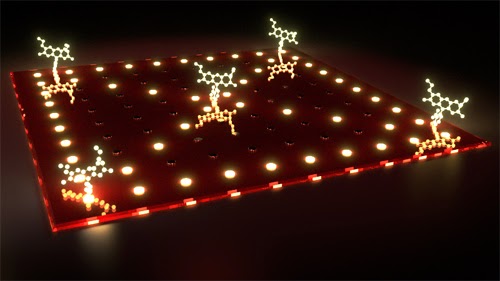
A Kansas State University chemical engineer has discovered that a new member of the ultrathin materials family has great potential to improve electronic and thermal devices.
Vikas Berry, William H. Honstead professor of chemical engineering, and his research team have studied a new three-atom-thick material -- molybdenum disulfide -- and found that manipulating it with gold atoms improves its electrical characteristics. Their research appears in a recent issue of Nano Letters.
The research may advance transistors, photodetectors, sensors and thermally conductive coatings, Berry said. It could also produce ultrafast, ultrathin logic and plasmonics devices.
Berry's laboratory has been leading studies on synthesis and properties of several next-generation atomically thick nanomaterials, such as graphene and boron-nitride layers, which have been applied for sensitive detection, high-rectifying electronics, mechanically strong composites and novel bionanotechnology applications.
"Futuristically, these atomically thick structures have the potential to revolutionize electronics by evolving into devices that will be only a few atoms thick," Berry said.
For the latest research, Berry and his team focused on transistors based on molybdenum disulfide, or MoS2, which was isolated only two years ago. The material is made of three-atom-thick sheets and has recently shown to have transistor-rectification that is better than graphene, which is a single-atom-thick sheet of carbon atoms.
When Berry's team studied molybdenum disulfide's structure, they realized that the sulfur group on its surface had a strong chemistry with noble metals, including gold. By establishing a bond between molybdenum disulfide and gold nanostructures, they found that the bond acted as a highly coupled gate capacitor.
Berry's team enhanced several transistor characteristics of molybdenum disulfide by manipulating it with gold nanomaterials.
"The spontaneous, highly capacitive, lattice-driven and thermally-controlled interfacing of noble metals on metal-dichalcogenide layers can be employed to regulate their carrier concentration, pseudo-mobility, transport-barriers and phonon-transport for future devices," Berry said.
The work may greatly improve future electronics, which will be ultrathin, Berry said. The researchers have developed a way to reduce the power that is required to operate these ultrathin devices.
"The research will pave the way for atomically fusing layered heterostructures to leverage their capacitive interactions for next-generation electronics and photonics," Berry said. "For example, the gold nanoparticles can help launch 2-D plasmons on ultrathin materials, enabling their interference for plasmonic-logic devices."
The research also supports the current work on molybdenum disulfide-graphene-based electron-tunneling transistors by providing a route for direct electrode attachment on a molybdenum disulfide tunneling gate.
"The intimate, highly capacitive interaction of gold on molybdenum disulfide can induce enhanced pseudo-mobility and act as electrodes for heterostructure devices," said T.S. Sreeprasad, a postdoctoral researcher in Berry's group.
The researchers plan to create further complex nanoscale architectures on molybdenum disulfide to build logic devices and sensors.
"The incorporation of gold into molybdenum disulfide provides an avenue for transistors, biochemical sensors, plasmonic devices and catalytic substrate," said Phong Nguyen, a doctoral student in chemical engineering, Wichita, Kan., who is part of Berry's research team.
Namhoon Kim, master's student in grain science and industry, Korea,worked on the research as an undergraduate in chemical engineering.