Showing posts with label cellulose. Show all posts

Tuesday, May 26, 2015

A new kind of biodegradable computer wood chip

A cellulose nanofibril (CNF) computer chip rests on a leaf. Photo: Yei Hwan Jung, Wisconsin Nano
Engineering Device Laboratory

Portable electronics — typically made of non-renewable, non-biodegradable and potentially toxic materials — are discarded at an alarming rate in consumers' pursuit of the next best electronic gadget.

In an effort to alleviate the environmental burden of electronic devices, a team of University of Wisconsin-Madison researchers has collaborated with researchers in the Madison-based U.S. Department of Agriculture Forest Products Laboratory (FPL) to develop a surprising solution: a semiconductor chip made almost entirely of wood.

The research team, led by UW-Madison electrical and computer engineering professor Zhenqiang "Jack" Ma, described the new device in a paper published today (May 26, 2015) by the journal Nature Communications. The paper demonstrates the feasibility of replacing the substrate, or support layer, of a computer chip, with cellulose nanofibril (CNF), a flexible, biodegradable material made from wood.

"The majority of material in a chip is support. We only use less than a couple of micrometers for everything else," Ma says. "Now the chips are so safe you can put them in the forest and fungus will degrade it. They become as safe as fertilizer."

Zhiyong Cai, project leader for an engineering composite science research group at FPL, has been developing sustainable nanomaterials since 2009.

"If you take a big tree and cut it down to the individual fiber, the most common product is paper. The dimension of the fiber is in the micron stage," Cai says. "But what if we could break it down further to the nano scale? At that scale you can make this material, very strong and transparent CNF paper."

"You don't want it to expand or shrink too much. Wood is a natural hydroscopic material and could attract moisture from the air and expand," Cai says. "With an epoxy coating on the surface of the CNF, we solved both the surface smoothness and the moisture barrier."Working with Shaoqin "Sarah" Gong, a UW-Madison professor of biomedical engineering, Cai's group addressed two key barriers to using wood-derived materials in an electronics setting: surface smoothness and thermal expansion.

Gong and her students also have been studying bio-based polymers for more than a decade. CNF offers many benefits over current chip substrates, she says.
"The advantage of CNF over other polymers is that it's a bio-based material and most other polymers are petroleum-based polymers. Bio-based materials are sustainable, bio-compatible and biodegradable," Gong says. "And, compared to other polymers, CNF actually has a relatively low thermal expansion coefficient."

The group's work also demonstrates a more environmentally friendly process that showed performance similar to existing chips. The majority of today's wireless devices use gallium arsenide-based microwave chips due to their superior high-frequency operation and power handling capabilities. However, gallium arsenide can be environmentally toxic, particularly in the massive quantities of discarded wireless electronics.

Yei Hwan Jung, a graduate student in electrical and computer engineering and a co-author of the paper, says the new process greatly reduces the use of such expensive and potentially toxic material.

"I've made 1,500 gallium arsenide transistors in a 5-by-6 millimeter chip. Typically for a microwave chip that size, there are only eight to 40 transistors. The rest of the area is just wasted," he says. "We take our design and put it on CNF using deterministic assembly technique, then we can put it wherever we want and make a completely functional circuit with performance comparable to existing chips."

While the biodegradability of these materials will have a positive impact on the environment, Ma says the flexibility of the technology can lead to widespread adoption of these electronic chips.

"Mass-producing current semiconductor chips is so cheap, and it may take time for the industry to adapt to our design," he says. "But flexible electronics are the future, and we think we're going to be well ahead of the curve."

Source: http://www.news.wisc.edu/23805

Monday, March 3, 2014

Boosting Bioenergy

Computer simulations are revealing the biological barriers that prevent the conversion of biomass into energy.
A team led by Oak Ridge National Laboratory’s Jeremy Smith, the director of ORNL’s Center for Molecular Biophysics and a Governor’s Chair at the University of Tennessee, has uncovered information that could help others harvest energy from plant mass. The team’s conclusion—that less ordered cellulose fibers bind less lignin—was published in the August edition of Biomacromolecules.
The team used simulations on the Oak Ridge Leadership Computing Facility’s Jaguar supercomputer—a 2.3-petaflop machine that in 2012 morphed into Titan, which is a more than 27-petaflop supercomputer—along with neutron scattering to seek ways to make ethanol as cheap as gasoline at the pump.
“We are trying to figure out how to effectively break down plant materials like grass or wood chips cheaply enough to make biofuels economically viable,” said Loukas Petridis, a researcher in the Biosciences Division. “We are investigating the two main features that make biomass recalcitrant, or resistant to breakdown—the presence of lignin and the tightly ordered structure of cellulose.”

Lignin’s legacy

All plants contain a sticky molecule called lignin that intertwines with cellulose and hemicellulose in their cell walls. This substance is one of the major roadblocks preventing the cost-effective production of cellulosic ethanol.
Lignin is a plant cell’s first defense against man and beast. It provides strength to the stalks of plants so that these organisms can stand. But a plant’s best friend is a bioenergy researcher’s worst nightmare. During biofuel production—a process that converts plant mass into alcohol—lignin blocks enzymes from breaking down cellulose into the sugars necessary for fermentation.
Petridis works with ORNL’s Biofuels Science Focus Area, a multidisciplinary research group with experts in math, computer science, physics, chemistry, and biology who are working on the lignin problem. By studying lignin–cellulose and lignin–lignin interactions, the scientists have learned more about the physical processes that occur during biomass pretreatment, which is an expensive process that opens plant cell walls and helps enzymes break down plant mass.
“The process is very effective,” Petridis said. “Without it you wouldn’t be able to produce biofuels, but we want to improve it further so that the production of biofuels becomes cheaper and more efficient. In order to do this, we have to understand what is taking place during pretreatment on a molecular level.”

Combining the powers of neutrons and simulations

Neutron imaging and supercomputer simulation allow scientists to resolve the structure of lignin aggregates down to 1 angstrom, about 1 million times smaller than what the naked eye can see.
A previous simulation on Jaguar showed how different pretreatment temperatures change lignin’s structure, causing it to either aggregate or expand. Petridis’s study builds on this finding.
Using neutron beams at ORNL’s High Flux Isotope Reactor, researchers have discovered that cellulose fibers that are less organized, or noncrystalline, are easier for enzymes to break down. Simulations run on Jaguar helped explain this phenomenon.
“Jaguar has shown us that not only is noncrystalline cellulose more easily broken down, but it also associates less with lignin,” Petridis said. “This was the first simulation that has looked at the interaction of lignin with specific types of cellulose.”
But researchers often want to learn why a process is occurring on a more fundamental level. Fortunately computer models also reveal the reason behind lignin’s preference for crystalline cellulose.
“It is harder for lignin to associate with the noncrystalline cellulose because this cellulose interacts very strongly with water,” Petridis said. “To see this we needed Jaguar’s enormous supercomputing power to simulate 3 million lignin, cellulose, and water molecules.”
Interaction between cellulose fibril (blue) and lignin (pink) molecules. Visualization by Jamison Daniel (ORNL)

Accelerating scientific discovery

Smaller supercomputers can simulate a cellulose fiber and one lignin molecule, but they often miss many of the molecular interactions that ORNL supercomputers like Jaguar or Titan can capture.
Smith’s team was awarded 23 million processor hours on Jaguar in 2012 through the Innovative and Novel Computational Impact on Theory and Experiment, or INCITE, program.
Under the INCITE allocation, the team ran a classic molecular dynamics simulation with a code called GROMACS (for Groningen Machine for Chemical Simulations). The code monitored 3 million atoms and used 30,000 of Jaguar’s cores, which means that each core was responsible for 100 atoms. The application provides information on the interaction of water with the cellulose, degree of lignin aggregation, shapes of lignin molecules, diffusion constants, etc.
The researchers received another 78 million INCITE hours this year to run an adapted version of GROMACS that can take advantage of Titan’s speedy GPUs, making the updated application 10 times bigger and much faster than the one run on Jaguar.
The Titan supercomputer is capable of more than 27,000 trillion calculations per second, and is the fastest open-science supercomputer in America. OLCF’s hybrid machine includes CPUs and NVIDIA GPUs, which are computational accelerators originally found in gaming systems. The GPUs provide the processing power needed to simulate larger and more realistic systems and accelerate scientific discovery.
Current simulations track around 30 million atoms, which include crystalline and noncrystalline cellulose, lignin, enzymes and water molecules. The models also account for the long-range interactions that lignin molecules experience with other surrounding molecules. These interactions make the code especially difficult to scale because the processors have to exchange information very frequently to monitor the position of every atom every fraction of a second.
“If you compare our 3-million-atom simulation to our 30-million-atom simulation, you can guess that we’ll eventually be able to simulate a billion atoms, which is the size of a living cell,” said Smith. “Our simulations could even include the microbes that eat the biomass.”
The team is now studying how lignin behaves in different types of biomass, which will help the researchers identify the plant characteristics best suited for biofuel production.
“The scientific insights we gain help improve the biofuel production process,” Petridis said. “We give engineers hints about how the production process works, which we hope will allow them to design new pretreatment methods and engineer different types of biomass and enzymes that can harvest more energy from plant materials.”

Bigger, faster supercomputers

As supercomputing power increases, Petridis’s team will be able to simulate longer biological processes in greater detail. The simulations they run are already high resolution, but they can simulate only processes that happen within milliseconds.

“We can simulate lignin aggregation because it takes place in a millisecond, but there are other interesting biological processes that take much longer than 1 millisecond,” Petridis said. “The future of supercomputing is being able to access time and length scales that are currently accessible only through neutron scattering experiments.” —Jennifer Brouner
Source: https://www.olcf.ornl.gov/2014/01/02/boosting-bioenergy/

Monday, January 6, 2014

The Complexity of Catalytically "Cracking" Cellulose

Molecule's carbon chain length affects oxygen's departure in key reaction for building bio-fuels


In a maze of blindingly complex reactions that snap oxygen atoms off cellulose or other bio-sources to create energy-dense fuel, the starting molecule's size has a curious effect. If the oxygen-rich molecule is too short to comfortably stretch to a catalyst's active site, oxygen atoms are split from its hydrocarbon chain instead of staying together as happens when the molecule can reach across, according to scientists at Pacific Northwest National Laboratory (PNNL) and Baylor University. The team uncovered this steric effect by comparing two cellulose stand-ins that each have two oxygens or hydroxyl groups. Iterating between experimental and computational studies, they learned that the longer molecule keeps its last oxygen until the last step. The shorter one drops its oxygen atoms earlier as it struggles to fit on the catalyst's surface.
"It's safe to say that we didn't expect the chemistry to be this complex," said Dr. Roger Rousseau, a computational chemist at PNNL who worked on the study. "We've done a lot of research into alcohols, but extrapolating from one hydroxyl group to two was an order of magnitude more complex."
Why It Matters: Economic, environmental, and security concerns are tied to the global need for energy. World energy consumption is predicted to grow by 56 percent between 2010 and 2040, with almost 80 percent of that energy coming from fossil fuels. Replacing those fuels in industrial applications could reduce these concerns. However, transforming bio-feedstock into fuels means quickly and efficiently removing oxygen atoms. To do this, scientists need to understand how and why the atoms behave as they do. This study uncovers the hidden reactions using molecular stand-ins, known as diols, on a prototypical catalyst.
"It looks as if it should be simple; you pull the oxygen off the biomass and get hydrocarbons. The reality is that it is a pretty complex reaction with a lot of intermediate steps," said Dr. Zdenek Dohnálek, an experimental chemist at PNNL who led the research. "Our research -- generating the elementary steps in oxygen removal -- is contributing to an uncharted area."
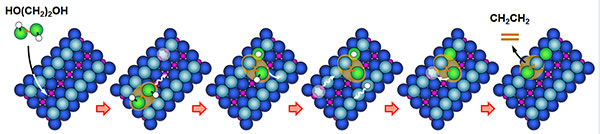
Methods: To resolve the complexity of the reactions, the team compared the reaction of two diols on the prototypical oxide catalyst titanium dioxide. The diols were a longer 1,3-propylene glycol (HO(CH2)3OH) with a three-carbon backbone and the shorter ethylene glycol (HO(CH2)2OH) with just two carbon atoms.
"It took more than three years to compare and contrast the reactions," said Rousseau. "We'd come up with new ideas to explain what we were seeing. We'd measure. We'd do the calculations. And then, we'd do it all again until we knew what was happening," said Rousseau.
The measurements came from scanning tunneling microscopy (STM); the calculations, from complex density functional theory. Using STM and temperature-programmed desorption, the team determined which bonds were broken and which intermediates formed. "STM was critical to providing information," said Dohnálek. "In a sense, it was the only way we could disentangle what was happening -- imaging one molecule at a time."
The experimental team deposited each diol in a thin layer on titanium dioxide at low temperatures. The diol landed on the titanium rows of the catalyst with the molecule's oxygen atoms resting on the row of titanium atoms. The attached hydrogen in the hydroxyl group hopped on and off.
"This was as expected," said Dohnálek. "Then, it got surprisingly complex."
The team determined that the longer 1,3-propylene glycol reached out. The hydroxyl dropped into a nearby oxygen vacancy, a "hole" in the surface. The associated hydrogen broke off. "This was a standard acid base reaction that we have seen for alcohols," said Dohnálek.
The shorter ethylene glycol couldn't quite reach the oxygen vacancy. The hydroxyl group broke off from the hydrocarbon chain completely as the molecule struggled to reach the oxygen vacancy.
"This mechanism is different than what we typically see for alcohols," said Rousseau.
ethylene glycol on titanium dioxide
Ethylene glycol lands on titanium dioxide catalyst, with the oxygen atoms (green) resting on the row of titanium atoms. The attached hydrogen atoms (white) hop onto the nearby oxygen atoms (light blue). One of the molecule’s oxygen atoms falls into a nearby oxygen vacancy. At higher temperatures, the second oxygen atom also falls into another oxygen vacancy, which migrated across the surface. Heating leads to the cleavage of both oxygen atoms, leaving behind a hydrocarbon that comes off the surface. This sequence of steps, which are of interest to catalytic scientists, was described by the research team at PNNL and Baylor University. Copyright 2013. American Chemical Society
When the temperature was raised above ~400 K, they saw a new stable intermediate centered on the bridging oxygen row. This intermediate was a new dioxo species. Further heating led to the homolytic cleavage of the other oxygen, and the hydrocarbon then left the surface when the temperature was raised above ~500 K.
"Again this process was very different from the one we saw for alcohols as it proceeded by a hemolytic rather than heterolytic bond breaking and was a nonadiabatic," said Rousseau.   
"The reactions are wonderfully complex and fun to study," said Dohnálek.
What's Next? The team will be diving into further complexity when they apply what they've found here to tungsten trioxide catalysts and other catalytic materials.