Showing posts with label plastic. Show all posts

Monday, April 7, 2014

Fungi Discovered In The Amazon Will Eat Your Plastic

Plastic is perhaps one of the hugest environmental problems facing Humankind and virtually all animal species around the globe. Being well known for it’s low weight, every year over 300 million tons of plastic are produced in the planet. Estimations report more plastic produced in the first decade of the 21st century, than the entire amount produced in the last century.

Only in our planet oceans, around 46.000 pieces of plastic debris, known as nurdles, are floating in each square mile, killing up to 1 million sea birds 100 thousand sea mammals adding to an unknown number of countless fish, each year.
Moreover, as far as we Humans are concerned, bisphenol A, more known as BPA, the main dioxin released by plastic containers into food and bottled water, as reached a detectable level in 93% of the people in developed countries. BPA has been long ago proven to be a carcinogen element to the Human body. Not only that, also BPA’s are proven to induce cardiovascular disease, age and puberty, obesity and developmental disorders.
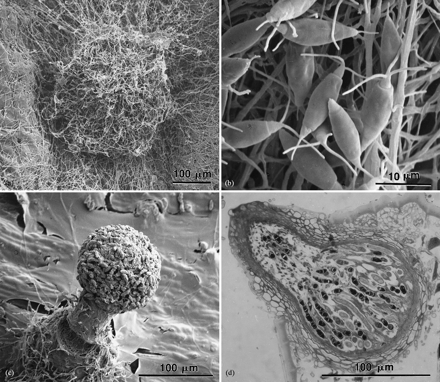
Primary fruiting structures of Pestalotiopsis microspora and Pestalosphaeria hansenii: (a) an acervulus of Pestalotiopsis microspora; (b) appendage-bearing conidiospores of Pestalotiopsis microspora; (c) a perithicium of Pestalosphaeria hansenii with an agglutinated mass of ascospores; (d) the asci of Pestalosphaeria hansenii located within a perithecium.
Due to it’s low rate of biodegradability, known to be able to take up to thousand of years to succeed, the amount of landfill goes up to 25% of all worldwide waste deposits, being from far the most comment element in them.
Being on the top of the environmental issues, a University of Yale team has recently performed a research on plastic eating fungi, and found a mushroom creating fungus able to bio-degrade polymer polyurethan, one of the most common type of worldwide produced plastic.
The Amazon is home to more species than almost anywhere else on earth. One of them, carried home recently by a group from Yale University, appears to be quite happy eating plastic in airless landfills.
The group of students, part of Yale’s annual Rainforest Expedition and Laboratory with molecular biochemistry professor Scott Strobel, ventured to the jungles of Ecuador. The mission was to allow "students to experience the scientific inquiry process in a comprehensive and creative way." The group searched for plants, and then cultured the microorganisms within the plant tissue. As it turns out, they brought back a fungus new to science with a voracious appetite for a global waste problem: polyurethane.
The fungi, Pestalotiopsis microspora, is the first anyone has found to survive on a steady diet of polyurethane alone and--even more surprising--do this in an anaerobic (oxygen-free) environment that is close to the condition at the bottom of a landfill.
Student Pria Anand recorded the microbe’s remarkable behavior and Jonathan Russell isolated the enzymes that allow the organism to degrade plastic as its food source. The Yale team published their findings in the journal Applied and Environmental Microbiologylate last year concluding the microbe is "a promising source of biodiversity from which to screen for metabolic properties useful for bioremediation." In the future, our trash compactors may simply be giant fields of voracious fungi.
Who knows what the students in the rainforest will turn up next?
http://aem.asm.org/content/77/17/6076

Tuesday, January 7, 2014

Nano-inspired packaging plastic protects as well as aluminium foil

The encapsulated nanoparticles layer (center and right) consists of nanoparticles encapsulated by an organic species (left) via a self-assembly method in which the nanoparticles concentration is very high—up to 70 to 80% by weight. Image: A*STAR
Tera-Barrier Films invents alternative stretchable plastic for prolonging shelf-life of pharmaceuticals, food and electronics

Tera-Barrier Films (TBF) Pte Ltd, a spin-off company from A*STAR’s Institute of Materials Research and Engineering’s (IMRE), has invented a new plastic film using a revolutionary nano-inspired process that makes the material thinner but as effective as aluminium foil in keeping air and moisture at bay. The stretchable plastic could be an alternative for prolonging shelf-life of pharmaceuticals, food and electronics, bridging the gap of aluminium foil and transparent oxide films.

The new plastic by TBF has one of the lowest moisture vapour transmission rates (mvtr), preventing air and moisture from penetrating the layer. The plastic has an air and moisture barrier that is about 10 times better than the transparent oxide barriers which are currently being used to package food and medicines owing to its uniquely encapsulated nanoparticle layer. The film has been validated by a number of companies and potential commercialisation partners.

TBF’s 700nm encapsulated nanoparticle barrier films - which are thinner than a strand of human hair - have high transparency and are also stretchable, features not possible with aluminium-based packaging material. Inorganic barrier thin films are highly transparent but have lower barrier property and are not stretchable. TBF’s films will allow see-through packing and a longer shelf-life for a wide range of products from high-end electronics to perishable goods. Stretchability is another attractive feature in facilitating simple packaging processes.

Aluminium as a metal has very high oxygen and moisture barrier properties, but aluminium-based packaging comes at a higher processing cost, is opaque, non-stretchable, and interferes with electronics, making the integration of components like RFID devices difficult. TBF’s new stretchable thin films are cost effective and transparent, with barrier properties comparable to that of aluminium foil.

“TBF’s strategy is to bridge the gap between aluminium foil and transparent oxide films by creating new packaging structures for the niche applications in the food, medical, pharmaceuticals and electronics markets,” said Mr Senthil Ramadas, Director & Chief Technology Officer of TBF. “The secret behind TBF’s film lies in our patented encapsulated nanoparticle layer that consists of nanoparticles in polymer shells”.

Conventional multilayer barrier plastics have successive layers of barrier plastic films to enhance the impermeability to air and moisture but they have not achieved higher barrier properties. TBF’s film uses minimal layers as its encapsulated nanoparticles increase the packing density of nanoparticles, which in turn makes it extremely difficult for water and oxygen molecules to pass through the film. The encapsulated nanoparticles also actively adsorb and react with water and oxygen molecules to trap them, thus further lowering the amount of moisture and air passing through the film.

“The innovation creates a whole new generation of packaging materials that add new and superior functions for use in high value products such as medicine”, says Professor Andy Hor, Executive Director of A*STAR’s IMRE from where the unique barrier film technology was initially developed, incubated and spun-off. “We are glad to see our scientist-entrepreneurs advancing an IMRE-born technology and are looking forward to seeing it make an impact in the market”.

“The University of Tokyo confirmed TBF’s barrier film performance at 10-6g/m2/day”, said Mr. Nakazawa, Managing Director, KISCO (Asia) Pte. Ltd. “There has been very favourable response from our potential customers in a spectrum of industries wishing to benefit by incorporating TBF’s superior barrier films into their products, these applications range from food and medical packaging to high end PV, lighting and display sectors where TBF’s barrier films excel.”

TBF was recently recognised by leading Global Growth consulting firm, Frost & Sullivan as the ‘2013 Global Next Generation Technology Company of the Year in the field of Barrier Films’ due to its novel approach of developing innovative technology for its patented barrier material and barrier stack technology that enhances the performance and reliability of barrier films. TBF has pioneered a unique and innovative technology for developing barrier films, by using nanoparticles to plug the defects in the barrier oxide layer, thereby enhancing barrier effectiveness and at the same time, reducing the number of barrier layers needed.

TBF’s reduced number of barrier layers and lower material costs, as compared to conventional barrier film technologies, brings in tremendous cost efficiencies into TBF’s manufacturing process. With TBF’s unique technology and low cost, access to newer applications like Quantum dot color filters, Vacuum Insulated Panels (VIPs), Food & Medical Packaging has been made possible in addition to the conventional application areas like OLED displays or lighting and flexible Solar cells. This opens up a wide spectrum of opportunities for the barrier films market and TBF’s barrier films are well positioned to address the needs from these new and emerging applications.

Tuesday, December 10, 2013

IBM Scientists Demonstrate Quantum Phenomenon for the First Time Using a Plastic Film

For the first time, scientists at IBM Research (NYSE: IBM) have demonstrated a complex quantum mechanical phenomenon known as Bose-Einstein condensation (BEC), using a luminescent polymer (plastic) similar to the materials in light emitting displays used in many of today's smartphones.
This discovery has potential applications in developing novel optoelectronic devices including energy-efficient lasers and ultra-fast optical switches — critical components for powering future computer systems to process massive Big Data workloads. The use of a polymer material and the observation of BEC at room temperature provides substantial advantages in terms of applicability and cost. 
IBM scientists around the world are focused on an ambitious data centric exascale computing program, which is aimed at developing systems that can process massive data workloads fifty times faster than today. Such a system will need optical interconnects capable of high-speed processing of Petabytes to Exabytes of Big Data. This will enable high-performance analytics for: energy grids, life sciences, financial modelling, business intelligence and weather and climate forecasting. 
The complex phenomenon IBM scientists demonstrated at room temperature is named after the renown scientists Satyendranath Bose and Albert Einstein who first predicted it in the mid-1920s and only later experimentally proven in 1995. 
A Bose-Einstein Condensate is a peculiar state of matter which occurs when a dilute gas of particles (bosons) are cooled to nearly absolute zero (-273 Celsius, -459 Fahrenheit). At this temperature intriguing macroscopic quantum phenomena occur in which the bosons all line up like ballroom dancers. 
In 1995 this was demonstrated for the first time at these extreme temperatures, but today in a paper appearing in Nature Materials, IBM scientists have achieved the same state at room temperature using a thin non-crystalline polymer film developed by chemists at the University of Wuppertal in Germany. 
In the experiment, a thin polymeric layer is placed between two mirrors and excited with laser light. This thin plastic film is approximately 35 nanometers thick, for comparison a sheet of paper is about 100,000 nanometers thick. The bosonic particles are created through interaction of the polymer material and light which bounces back and forth between the two mirrors. 
The phenomenon only lasts for a few picoseconds (one trillionth of a second), but the scientists believe this is already long enough to use the bosons to create a source of laser-like light and/or an optical switch for future optical interconnects. These components are important building blocks to control the flow of information in the form of zeroes and ones between future chips and can significantly speed up their performance while using much less energy. 
"That BEC would be possible using a polymer film instead of the usual ultra-pure crystals defied our expectations," said Dr. Thilo Stoferle, a physicist, at IBM Research. "It's really a beautiful example of quantum mechanics where one can directly see the quantum world on a macroscopic scale." 
The next step for scientists is to study and control the extraordinary properties of the Bose-Einstein Condensate and to evaluate possible applications including analog quantum simulations. Such simulations could be used to model very complex scientific phenomena such as superconductivity, which is difficult using today's computational approaches.
The research was funded under the European Union's FP7 Project named ICARUS. The goal of ICARUS is to create and characterize new hybrid-semiconductor systems and then implement them in photonic and optoelectronic devices. For more information visitwww.icarus.group.shef.ac.uk 
This research was conducted in the Binnig and Rohrer Nanotechnology Center at IBM Research - Zurich. 
The scientific paper entitled "Room-temperature BoseEinstein condensation of cavity excitonpolaritons in a polymer"   by Johannes D. Plumhof, Thilo Stoferle, Lijian Mai, Ullrich Scherf and Rainer F. Mahrt, appears in Nature Materials, DOI: 10.1038/NMAT3825

Tuesday, November 26, 2013

Turning plastic bags into high-tech materials

Nanotechnological Recycling

University of Adelaide researchers have developed a process for turning waste plastic bags into a high-tech nanomaterial.

The innovative nanotechnology uses non-biodegradable plastic grocery bags to make 'carbon nanotube membranes' ‒ highly sophisticated and expensive materials with a variety of potential advanced applications including filtration, sensing, energy storage and a range of biomedical innovations.

"Non-biodegradable plastic bags are a serious menace to natural ecosystems and present a problem in terms of disposal," says Professor Dusan Losic, ARC Future Fellow and Research Professor of Nanotechnology in the University's School of Chemical Engineering.

"Transforming these waste materials through 'nanotechnological recycling' provides a potential solution for minimising environmental pollution at the same time as producing high-added value products."

Carbon nanotubes are tiny cylinders of carbon atoms, one nanometre in diameter (1/10,000 the diameter of a human hair). They are the strongest and stiffest materials yet discovered - hundreds of times stronger than steel but six times lighter - and their unique mechanical, electrical, thermal and transport properties present exciting opportunities for research and development. They are already used in a variety of industries including in electronics, sports equipment, long-lasting batteries, sensing devices and wind turbines.

The University of Adelaide's Nanotech Research Group has 'grown' the carbon nanotubes onto nanoporous alumina membranes. They used pieces of grocery plastic bags which were vaporised in a furnace to produce carbon layers that line the pores in the membrane to make the tiny cylinders (the carbon nanotubes). The idea was conceived and carried out by PhD student Tariq Altalhi.

"Initially we used ethanol to produce the carbon nanotubes," says Professor Losic. "But my student had the idea that any carbon source should be useable."

The huge potential market for carbon nanotubes hinges on industry's ability to produce large quantities more cheaply and uniformly. Current synthesis methods usually involve complex processes and equipment, and most companies on the market measure production output in only several grams per day.

"In our laboratory, we've developed a new and simplified method of fabrication with controllable dimensions and shapes, and using a waste product as the carbon source," says Professor Losic.

The process is also catalyst and solvent free, which means the plastic waste can be used without generating poisonous compounds.

This research has been published online ahead of print in the journal Carbon.

Source: http://www.adelaide.edu.au/news/news65022.html?q=carbon%20nanotubes

Tuesday, September 3, 2013

Plastic – the new energy source

QUT's research to develop cheap plastic solar cells to charge mobile phones and other electronic devices has been boosted with the installation of one of the most powerful nanotechnology microscopes in the world.
The only one if its kind in Australia, the Zeiss Orion NanoFab enables researchers to examine natural or manmade structures in incredible detail, and will create new insights wherever it is applied.
By increasing the microscope beam current, researchers are able to etch away material to create patterns or structures with features of only a few nanometres. This is a tool that can write lines 100,000 times finer than the text on a printed page. Imagine War and Peace etched on the head of a pin - 200 times over.
QUT nanotechnology expert, Professor Nunzio Motta, said the new microscope complemented QUT's existing tunnelling microscope, the only one of its kind in Queensland, and would cement the university's place at the cutting edge of Australian nanotechnology research.
He said the super microscopes would be used to create new nanostructures which could be used in electronic devices, solar cells, gas sensors and for a range of other uses.
"At the moment plastic solar cells are quite inefficient and researchers around the world are trying to determine how to make the cells efficient and able to be commercialised," Professor Motta said.
"The advantages cheap solar cells would produce would be enormous.
"In the future plastic solar cells could generate enough energy not only to recharge the batteries of laptops and mobiles, but even to obtain power from canopies on parking areas which could be fed back into grids.
"They could even be developed as a clear film on glass windows to produce power."
Professor Motta is currently using the tunnelling microscope to improve plastic solar cells by mixing them with graphene, an atomic-scale honeycomb lattice made of carbon atoms. He has found that adding gold nano-particles traps light and improves efficiency.
"While it's difficult to put a timeframe on the development of efficient plastic solar cells, a five to ten year goal is probably not unrealistic," he said.
Professor Motta said his research team also hoped to create a new class of solar-powered nano-sensors capable of detecting pollution and monitoring the environment in remote areas.
He said nanoscale science was critical to the world's future economy as advances would transform a range of scientific and engineering disciplines.
Professor Motta said QUT was organizing NanoS-E3, an International Workshop and School on nanotechnology at Airlie Beach in September.
The initiative, in partnership with the Italian and Australian governments, will build on existing nanotechnology networks and foster new collaborations. In 2013, the workshop will also welcome scientists from France, Germany, Japan, Canada and the USA.