Showing posts with label magnets. Show all posts

Monday, September 14, 2015

First realization of an electric circuit with a magnetic insulator using spin waves


Physicists at the University of Groningen, together with colleagues from Utrecht and Brest, have discovered a new principle governing how information is sent between electronic circuits. This could also help generate electricity more efficiently from temperature differences. The results were published on 14 September in the journal Nature Physics.

The research was led by Bart van Wees, Professor of Applied Physics at the University of Groningen and specialist in fields such as spintronics. This is a form of electronics in which not only the electrons count, but their spin is important too. Each electron has a spin, a quantum mechanical phenomenon that can have two values: up or down. You can ‘code’ an electron with information and transport it using ‘spin currents’.

In the new research Ludo Cornelissen, a PhD student supervised by Van Wees, showed that spin currents could pass through isolators too. In the experiment a conductive material was combined with a non-conductive magnetic material. When electrons collide with the non-conductive material they cannot continue, but a change in the magnetization occurs during the collision that means that the spin is passed on.


‘We designed an experiment where we converted an electron current into a spin wave. It then turned back into an electron current a bit further along,’ Van Wees explains. The spin wave in the non-conductive magnetic material is what is known as a magnon, a disruption in the magnetization that spreads like a wave does through a full stadium: electrons in the material pass the spin on to their neighbours before falling back into their original position. With this form of transport only the spin moves, and the electrons do not travel around. This means heat does not develop and the transport requires very little energy.

‘We are therefore the first to have linked the concept of spin transport to magnetization dynamics and to have shown that spin transport is also possible in isolators’, explains Van Wees. That presents new possibilities. ‘During the transport through the isolator you can manipulate the spin wave, for example through magnetic fields’, explains Van Wees. Spin waves gradually die down due to interaction with the atoms in the crystal grid, but Van Wees and his colleagues have shown that the spin wa0-+ve is maintained for at least 10 micrometres. ‘And that is plenty long enough.

However, the longer the wave, the more sensitive it is to change. You could, for example, use it to make sensors that detect magnetism.’

It is also possible to use a spin wave to switch magnetic bits. ‘With spin waves you can switch a smaller surface than with electromagnetic techniques, and the energy consumption is much better too.’ Such applications are not necessarily that far away. ‘I prefer to work with normal materials at room temperature so that the step to applications is small.’

Another possible application is in thermoelectricity, the conversion of temperature differences into electricity. ‘Materials that are suited to this are all electrical conductors, but an electrical conductor will by definition also conduct heat. This means that part of the temperature difference will leak away.’ The few companies that want to bring thermoelectricity onto the market are therefore struggling with yields that are way below the theoretical possibilities. ‘With our material you can generate a spin current in an isolator that therefore does not let any heat through. That opens the way to a higher yield.’
Monday, June 8, 2015

Ultrafast heat conduction can manipulate nanoscale magnets


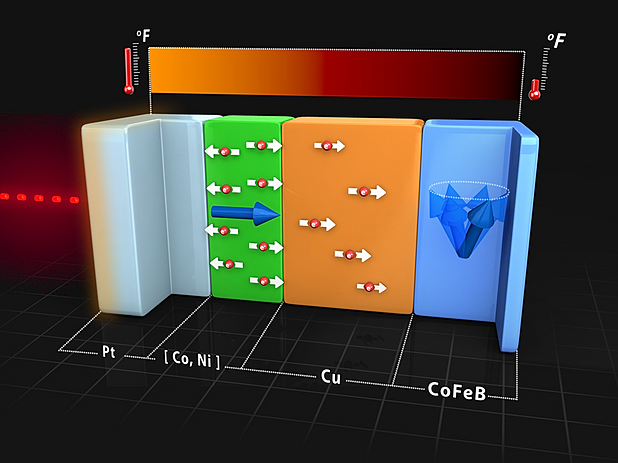
Researchers at the University of Illinois at Urbana-Champaign have uncovered physical mechanisms allowing the manipulation of magnetic information with heat. These new phenomena rely on the transport of thermal energy, in contrast to the conventional appication of magnetic fields, providing a new, and highly desireable way to manipulate magnetization at the nanoscale.

“In our study, we make use of the fact that a heat current passing through a magnetic material creates a separation of electron spins. This process creates a current of magnetic dipoles that we use to manipulate the orientation of a second magnetic layer,” said David Cahill, a Donald B. Willett Professor of Engineering and head of theDepartment of Materials Science and Engineering at Illinois. “The physics of separating spins with heat currents is related to the operation of thermocouples and the thermoelectric generators that power deep space probes. In those thermoelectric devices, a heat current causes a separation of electrical charges. That separation of electrical charge can then be used to measure a temperature or provide electrical power.”

“We use the spin current created by ultrafast heat conduction to generate spin transfer torque. Spin transfer torque is the transfer of the spin angular momentum from conduction electrons to the magnetization of a ferromagnet and enables the manipulation of nanomagnets with spin currents rather than magnetic fields,” explained Gyung-Min Choi, who recently completed his PhD  in materials science and engineering at Illinois. “Spin transfer torque has often been realized by passing electrical currents through magnetic layers. In our paper, we showed how spin transfer torque can be generated by an intense current of heat.”

Choi is lead author of the paper, “Thermal spin transfer torque driven by the spin-dependent Seebeck effect in metallic spin-valves,” published in Nature Physics. (The term “Seebeck effect” refers to a thermoelectric phenomenon by which temperature differences between two dissimilar materials in a circuit  generates a voltage. The spin-dependent Seebeck effect refers to the analogous phenomenon involving the spin of electrons in a ferromagnet.)

“We quantify thermal spin transfer torque in metallic spin valve structures using an intense and ultrafast heat current created by picosecond—one trillionth of a second—pulses of laser light,” Cahill added. “This heat current has the impressively large magnitude of 100 GW per square meter and persists for approximately 50 trillionths of a second. The sign and magnitude of the heat-driven spin current can be controlled by the composition of a ferromagnetic layer and thickness of a heat sink layer.”

Cahill’s research group at Illinois studies the physical mechanisms governing the interplay of spin and heat at the nanoscale, addressing the fundamental limits of ultrafast spintronic devices for data storage and information processing. In addition to Choi and Cahill--whose work was supported by the Army Research Office MURI program--co-authors of the paper include Byoung-Chul Min, Center for Spintronics Research, Korea Institute of Science and Technology, Seoul; and Kyung-Jin Lee, Department of Materials Science and Engineering and KU-KIST Graduate School of Converging Science and Technology, Korea University, Seoul.

Tuesday, March 4, 2014

Relativity shakes a magnet

©: Jairo Sinova
Electrically shaken GaMnAs magnet

Researchers from Mainz University demonstrate a new principle for magnetic recording


The research group of Professor Jairo Sinova at the Institute of Physics at Johannes Gutenberg University Mainz (JGU), in collaboration with researchers from Prague, Cambridge, and Nottingham, have predicted and discovered a new physical phenomenon that allows to manipulate the state of a magnet by electric signals. 

Current technologies for writing, storing, and reading information are either charge-based or spin-based. Semiconductor flash or random access memories are prime examples among the large variety of charge-based devices. They utilize the possibility offered by semiconductors to easily electrically manipulate and detect their electronic charge states representing the "zeros" and "ones". 

The downside is that weak perturbations such as impurities, temperature change, or radiation can lead to uncontrolled charge redistributions and, as a consequence, to data loss. Spin-based devices operate on an entirely distinct principle. In some materials, like iron, electron spins generate magnetism and the position of the north and south pole of the magnet can be used to store the zeros and ones. 

This technology is behind memory applications ranging from kilobyte magnetic stripe cards to terabyte computer hard disks. Since they are based on spin, the devices are much more robust against charge perturbations. However, the drawback of current magnetic memories is that in order to reverse the north and south poles of the magnet, i.e., flip the zero to one or vice versa, the magnetic bit has to be coupled to an electro-magnet or to another permanent magnet. If instead one could flip the poles by an electric signal without involving another magnet, a new generation of memories can be envisaged combining the merits of both charge and spin-based devices.
In order the shake a magnet electrically without involving an electro-magnet or another permanent magnet one has to step out of the realm of classical physics and enter the relativistic quantum mechanics. Einstein’s relativity allows electrons subject to electric current to order their spins so they become magnetic. The researchers took a permanent magnet GaMnAs and by applying an electric current inside the permanent magnet they created a new internal magnetic cloud, which was able to manipulate the surrounding permanent magnet. The work has been published in the journal Nature Nanotechnology.
The observed phenomenon is closely related to the relativistic intrinsic spin Hall effect which Jörg Wunderlich, Jairo Sinova, and Tomas Jungwirth discovered in 2004 following a prediction of Sinova and co-workers in 2003. Since then it has become a text-book demonstration of how electric currents can magnetize any material. "Ten years ago we predicted and discovered how electric currents can generate pure spin-currents through the intrinsic structure of materials. Now we have shown how this effect can be reversed to manipulate magnets by the current-induced polarization. These new phenomena are a major topic of research today since they can lead to new generation of memory devices. Besides our on-going collaborations, this research direction couples very well with on-going experimental research here in Mainz. Being part of this world-leading research and working with superb colleagues is an immense privilege and I am very excited about the future", said Sinova.
Source: http://www.uni-mainz.de/presse/17107_ENG_HTML.php