Showing posts with label Nanomagnets. Show all posts

Monday, June 8, 2015

Ultrafast heat conduction can manipulate nanoscale magnets


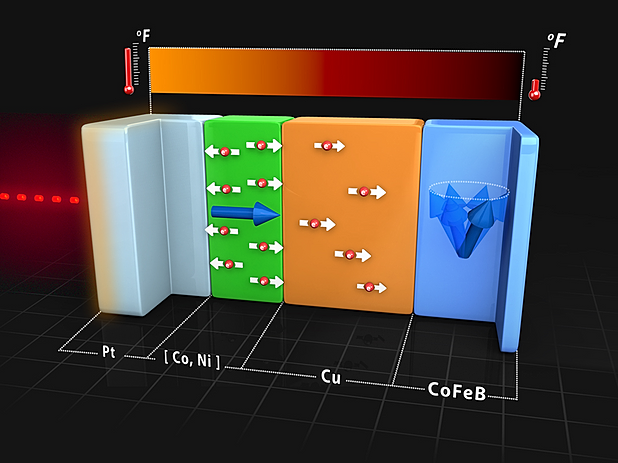
Researchers at the University of Illinois at Urbana-Champaign have uncovered physical mechanisms allowing the manipulation of magnetic information with heat. These new phenomena rely on the transport of thermal energy, in contrast to the conventional appication of magnetic fields, providing a new, and highly desireable way to manipulate magnetization at the nanoscale.

“In our study, we make use of the fact that a heat current passing through a magnetic material creates a separation of electron spins. This process creates a current of magnetic dipoles that we use to manipulate the orientation of a second magnetic layer,” said David Cahill, a Donald B. Willett Professor of Engineering and head of theDepartment of Materials Science and Engineering at Illinois. “The physics of separating spins with heat currents is related to the operation of thermocouples and the thermoelectric generators that power deep space probes. In those thermoelectric devices, a heat current causes a separation of electrical charges. That separation of electrical charge can then be used to measure a temperature or provide electrical power.”

“We use the spin current created by ultrafast heat conduction to generate spin transfer torque. Spin transfer torque is the transfer of the spin angular momentum from conduction electrons to the magnetization of a ferromagnet and enables the manipulation of nanomagnets with spin currents rather than magnetic fields,” explained Gyung-Min Choi, who recently completed his PhD  in materials science and engineering at Illinois. “Spin transfer torque has often been realized by passing electrical currents through magnetic layers. In our paper, we showed how spin transfer torque can be generated by an intense current of heat.”

Choi is lead author of the paper, “Thermal spin transfer torque driven by the spin-dependent Seebeck effect in metallic spin-valves,” published in Nature Physics. (The term “Seebeck effect” refers to a thermoelectric phenomenon by which temperature differences between two dissimilar materials in a circuit  generates a voltage. The spin-dependent Seebeck effect refers to the analogous phenomenon involving the spin of electrons in a ferromagnet.)

“We quantify thermal spin transfer torque in metallic spin valve structures using an intense and ultrafast heat current created by picosecond—one trillionth of a second—pulses of laser light,” Cahill added. “This heat current has the impressively large magnitude of 100 GW per square meter and persists for approximately 50 trillionths of a second. The sign and magnitude of the heat-driven spin current can be controlled by the composition of a ferromagnetic layer and thickness of a heat sink layer.”

Cahill’s research group at Illinois studies the physical mechanisms governing the interplay of spin and heat at the nanoscale, addressing the fundamental limits of ultrafast spintronic devices for data storage and information processing. In addition to Choi and Cahill--whose work was supported by the Army Research Office MURI program--co-authors of the paper include Byoung-Chul Min, Center for Spintronics Research, Korea Institute of Science and Technology, Seoul; and Kyung-Jin Lee, Department of Materials Science and Engineering and KU-KIST Graduate School of Converging Science and Technology, Korea University, Seoul.

Tuesday, March 4, 2014

Relativity shakes a magnet

©: Jairo Sinova
Electrically shaken GaMnAs magnet

Researchers from Mainz University demonstrate a new principle for magnetic recording


The research group of Professor Jairo Sinova at the Institute of Physics at Johannes Gutenberg University Mainz (JGU), in collaboration with researchers from Prague, Cambridge, and Nottingham, have predicted and discovered a new physical phenomenon that allows to manipulate the state of a magnet by electric signals. 

Current technologies for writing, storing, and reading information are either charge-based or spin-based. Semiconductor flash or random access memories are prime examples among the large variety of charge-based devices. They utilize the possibility offered by semiconductors to easily electrically manipulate and detect their electronic charge states representing the "zeros" and "ones". 

The downside is that weak perturbations such as impurities, temperature change, or radiation can lead to uncontrolled charge redistributions and, as a consequence, to data loss. Spin-based devices operate on an entirely distinct principle. In some materials, like iron, electron spins generate magnetism and the position of the north and south pole of the magnet can be used to store the zeros and ones. 

This technology is behind memory applications ranging from kilobyte magnetic stripe cards to terabyte computer hard disks. Since they are based on spin, the devices are much more robust against charge perturbations. However, the drawback of current magnetic memories is that in order to reverse the north and south poles of the magnet, i.e., flip the zero to one or vice versa, the magnetic bit has to be coupled to an electro-magnet or to another permanent magnet. If instead one could flip the poles by an electric signal without involving another magnet, a new generation of memories can be envisaged combining the merits of both charge and spin-based devices.
In order the shake a magnet electrically without involving an electro-magnet or another permanent magnet one has to step out of the realm of classical physics and enter the relativistic quantum mechanics. Einstein’s relativity allows electrons subject to electric current to order their spins so they become magnetic. The researchers took a permanent magnet GaMnAs and by applying an electric current inside the permanent magnet they created a new internal magnetic cloud, which was able to manipulate the surrounding permanent magnet. The work has been published in the journal Nature Nanotechnology.
The observed phenomenon is closely related to the relativistic intrinsic spin Hall effect which Jörg Wunderlich, Jairo Sinova, and Tomas Jungwirth discovered in 2004 following a prediction of Sinova and co-workers in 2003. Since then it has become a text-book demonstration of how electric currents can magnetize any material. "Ten years ago we predicted and discovered how electric currents can generate pure spin-currents through the intrinsic structure of materials. Now we have shown how this effect can be reversed to manipulate magnets by the current-induced polarization. These new phenomena are a major topic of research today since they can lead to new generation of memory devices. Besides our on-going collaborations, this research direction couples very well with on-going experimental research here in Mainz. Being part of this world-leading research and working with superb colleagues is an immense privilege and I am very excited about the future", said Sinova.
Source: http://www.uni-mainz.de/presse/17107_ENG_HTML.php

Friday, November 22, 2013

Milestone could help magnets end era of computer transistors

As current passes through a strip of tantalum, electrons
with opposite spins separate. Researchers used the resulting
polarization to create a nanomagnetic switch that
could one day replace computer transistors.
(Image by Debanjan Bhowmik, UC Berkeley)
New work by researchers at UC Berkeley could soon transform the building blocks of modern electronics by making nanomagnetic switches a viable replacement for the conventional transistors found in all computers.

Semiconductor-based transistors, the on-off switches that direct the flow of electricity and form a computer’s nervous system, have been consuming greater chunks of power at increasingly hotter temperatures as processing speeds grow. For more than a decade, researchers have been pursuing magnets as an alternative to transistors because they require far less energy needs when switching. However, until now, the power needed to generate the magnetic field to orient the magnets so they can easily clock on and off has negated much of the energy savings that would have been gained by moving away from transistors.
UC Berkeley researchers overcame this limitation by exploiting the special properties of the rare, heavy metal tantalum.
In a paper published online Sunday, Nov. 17, in the journal Nature Nanotechnology, the researchers describe how they created a so-called Spin Hall effect by using nanomagnets placed on top of tantalum wire and then sending a current through the metal. Electrons in the current will randomly spin in either a clockwise or counterclockwise direction. When the current is sent through tantalum’s atomic core, the metal’s physical properties naturally sort the electrons to opposing sides based on their direction of spin. This creates the polarization researchers exploited to switch magnets in a logic circuit without the need for a magnetic field.
“This is a breakthrough in the push for low-powered computing,” said study principal investigator Sayeef Salahuddin, UC Berkeley assistant professor of electrical engineering and computer sciences. “The power consumption we are seeing is up to 10,000 times lower than state-of-the-art schemes for nanomagnetic computing. Our experiments are the proof of concept that magnets could one day be a realistic replacement for transistors.”
Other co-authors of the study are graduate student and lead author Debanjan Bhowmik, and Long You, a research scholar.
The Defense Advanced Research Projects Agency, Semiconductor Research Corp. and the National Science Foundation helped support this work.

Wednesday, August 28, 2013

Magnetic charge crystals imaged in artificial spin ice

A team of scientists, led by University of Illinois physicist Peter Schiffer, has reported direct visualization of magnetic charge crystallization in an artificial spin ice material, a first in the study of a relatively new class of frustrated artificial magnetic materials-by-design known as “Artificial Spin Ice.” These charges are analogs to electrical charges with possible applications in magnetic memories and devices. The research team's findings appear in the August 29 issue of the journal Nature.

The unique properties of spin ice materials have fascinated scientists since they were first discovered in the late 1990s in naturally occurring rare earth titanites. The material is aptly named: the highly complex ordering of nanoscale magnets in spin ice obey the same rules that determine the positional ordering of hydrogen and oxygen atoms in frozen water ice. Both have “spin”—degrees of freedom—with frustrated interactions that prevent complete freezing, even at absolute zero.
In 2006, an interdisciplinary team of physicists and materials scientists designed the first artificial spin ice, a two-dimensional array of magnetic nanoislands that are fabricated to interact in complex ways, depending on the chosen design of the array. The islands were lithographically printed onto a substrate, arranged in a square-lattice pattern, with the north and south poles of each nanomagnet meeting and interacting at their four-pronged vertices.
Now the same research team has developed a new annealing protocol that allows the artificial material’s full potential for highly complex magnetic interactions to be realized. The new protocol was applied to two artificial spin ice materials, one configured in a square-lattice pattern, the other in a hexagonal-honeycomb pattern with three-pronged vertices.

In the honeycomb pattern, where three magnetic poles intersect, a net charge of north or south is forced at each vertex. The magnetic “monopole charge” at each vertex influences the magnetic “charge” of the surrounding vertices. The team was able to image the crystalline structure of the magnetic charges using magnetic force microscopy.
Magnetic force microscope image of emergent domains of ordered magnetic charges in honeycomb artificial spin ice. The black and white dots in the image are the north and south magnetic poles of the nanomagnets.
“Nanomagnets are so small that their behavior becomes relatively simple. We can arrange the magnets in a particular lattice pattern—square or honeycomb—and they interact in a way that we can predict and control,” Schiffer expained. “The challenge—you have to get the nanomagnets to flip their north and south poles to show how they interact. It’s hard to force them to show the effects of interaction, since they get stuck in one particular arrangement.”

The research team’s new annealing protocol—heating the material to a high temperature where their magnetic polarity is suppressed (here, about 550 degrees Celsius)—allows the nanomagnets to flip their polarity and freely interact. As the material cools, the nanomagnets are ordered according to the interactions of their poles at the vertices.

The collective thermal behavior of the arrays is studied through statistical mechanics, a branch of fundamental physics. As theorized, the monopole charge of each vertex was found to contribute to the order of the entire system in a manner analogous to the interactions of electric charges at the atomic scale during water ice crystal growth.

Los Alamos National Laboratory staff scientist Cristiano Nisoli explained, “The emergence of magnetic monopoles in spin ice systems is a particular case of what physicists call fractionalization, or deconfinement of quasi-particles that together are seen as comprising the fundamental unit of the system, in this case the north and south poles of a nanomagnet. We have seen how arranging magnets in a honeycomb configuration allows for these charges to be sort of ‘stripped’ from the magnetic islands to which they belong and become relevant degrees of freedom.”
The ability to use the magnetic charges as degrees of freedom has implications for future technological applications.
Map of the crystallites of ordered magnetic charges in honeycomb artificial spin ice. The red and blue dots correspond to vertices belonging to each of the two degenerate magnetic change-ordered states.
“Magnetic technology generally concerns itself with manipulation of localized dipolar degrees of freedom,” Nisoli said. “The ability of building materials containing delocalized monopolar charges is very exciting with possible technological implications in data storage and computation.”
An advantage of artificial spin ice is that it can be designed in different topologies, and examined subsequently to see the effects of those topologies. That allows physicists to explore a wide range of possible behaviors that are not accessible in natural crystals.
“This work demonstrates a direction in condensed matter physics that is quite opposite to what has been done in the last sixty decades or so,” said Nisoli. “Instead of imagining an emergent theoretical description to model the behavior of a nature-given material and validating it indirectly, we engineer materials of desired emergent properties that can be visualized directly.”
The theoretical work for this research was performed at Los Alamos National Laboratory under Cristiano Nisoli and Gia-Wei Chern, and at Penn State University under Vincent Crespi and Paul Lammert. Synthesis of the magnetic materials and the high temperature treatment was performed at the University of Minnesota’s Department of Chemical Engineering and Materials Science under Chris Leighton. Magnetic measurements and lithography were performed at Penn State University and the University of Illinois’ Frederick Seitz Materials Research Laboratory by graduate students Sheng Zhang and Ian Gilbert, under the direction of Peter Schiffer.
This research was supported by the U.S. Department of Energy and the National Science Foundation.