Showing posts with label Advanced Light Source. Show all posts

Friday, September 27, 2013

Superfast switching of a quantum light source

Usually, an elementary light source – such as an excited atom or molecule – emits light of a particular color at an unpredictable instance in time. Recently, however, scientists from the MESA+ Institute for Nanotechnology of the UT, FOM and the Institute for Nanoscience and Cryogenics (CEA/INAC) in France have shown that a light source can be coaxed to emit light at a desired moment in time, within an ultrashort burst. The superfast switching of a light source has applications in fast stroboscopes without laser speckle, in the precise control of quantum systems and for ultrasecure communication using quantum cryptography. The theoretical results appeared on 25 September in Optics Express.

Spontaneous emission of light from excited sources, such as atoms, molecules or quantum dots, is a fundamental process with many applications in modern technology, such as LEDs and lasers. As the term 'spontaneous emission' indicates, the emission is random in nature and it is therefore impossible to predict the exact emission time of a photon. However, for several applications it is desirable to receive single photons exactly when they are needed with as little uncertainty as possible. This property is crucial for ultra-secure communication using quantum cryptography and in quantum computers. Therefore, the important goal is to fabricate a quantum light source such that it emits a single photon exactly at a desired moment in time.
Switching light emission
The average emission time of quantum light sources can be reduced by locating them in various nanostructures, like optical resonators or waveguides. But the distribution of emission times is always exponential in time in a usual stationary environment. In addition, the smallest uncertainty in the emission time is limited by both the maximum intensity in the resonator and the variations in the preparation time of the emitter. The Dutch-French team proposes to overcome these limitations by quickly switching the resonator length, in which the light source is located. The time duration of the switch should be much shorter than the average emission time. The result is that the favored color of the resonator only matches the emission color of the light source within a short time interval. Only within this short time frame are the photons emitted by the light source into the resonator.
Cartoon of the superfast emission of a light source. The light source is embedded in an optical resonator where it spontaneously emits a photon. During the emission of the photon the favored color of the resonator is quickly switched symbolized by a hammer to match the color of the light source. During this short interval the light source is triggered to emit an ultrashort burst of photons within a desired moment in time.


Ultrafast light source
The researchers propose to use quantum dot light sources, which can easily be integrated in semiconductor optical resonators with lengths on the order of microns. The switching of the resonator will be achieved by shining an ultrashort laser pulse at the micropillar resonator during the emission time of the quantum dots. This quickly changes the refractive in the resonator and thereby the effective resonator length. The switching time can be directly controlled by the arrival time of the short laser pulse and by the lifetime of the excited electrons. These controlled light switches have great prospects for creating incoherent ultrafast light sources for fast stroboscopes without laser speckle, in quantum cryptography, in quantum information and for studying ultrafast cavity Quantum electrodynamics.

The team
The research has been performed by FOM postdoc Dr. Henri Thyrrestrup, Dr. Alex Hartsuiker and FOM workgroup leader Prof.dr. Willem L. Vos from the Complex Photonic Systems (COPS) Chair at the MESA+ Institute for Nanotechnology of the University of Twente in Enschede, The Netherlands, in close collaboration with Prof.dr. Jean-Michel Gérard from the Institute for Nanoscience and Cryogeny (CEA/INAC) in Grenoble, France.

The spontaneous emission intensity from a light source as function of time after excitation at time zero. The emission in a usual stationary environment follows an exponential curve (dashed curve); whereas the photons emitted by the light source placed in the switched optical resonator (red curve) can be bunched within a time window that is much shorter than the average emission time. The short intense burst of light is marked by the red area.
Based on a press release by the Dutch Foundation for Fundamental Research on Matter FOM.

Tuesday, August 20, 2013

‘Groovy’ hologram creates strange state of light at visible and invisible wavelengths

Nanostructured device controls the intensity, phase, and polarization of light for wide applications in optics
https://www.seas.harvard.edu/news/2013/08/groovy-hologram-creates-strange-state-of-light-at-visible-and-invisible-wavelengths Applied physicists at the Harvard School of Engineering and Applied Sciences (SEAS) have demonstrated that they can change the intensity, phase, and polarization of light rays using a hologram-like design decorated with nanoscale structures.
As a proof of principle, the researchers have used it to create an unusual state of light called a radially polarized beam, which—because it can be focused very tightly—is important for applications like high-resolution lithography and for trapping and manipulating tiny particles like viruses.
This is the first time a single, simple device has been designed to control these three major properties of light at once. (Phase describes how two waves interfere to either strengthen or cancel each other, depending on how their crests and troughs overlap; polarization describes the direction of light vibrations; and the intensity is the brightness.)
“Our lab works on using nanotechnology to play with light,” says Patrice Genevet, a research associate at Harvard SEAS and co-lead author of a paper published this month in Nano Letters. “In this research, we’ve used holography in a novel way, incorporating cutting-edge nanotechnology in the form of subwavelength structures at a scale of just tens of nanometers.” One nanometer equals one billionth of a meter.
Genevet works in the laboratory of Federico CapassoRobert L. Wallace Professor of Applied Physics and Vinton Hayes Senior Research Fellow in Electrical Engineering at Harvard SEAS. Capasso’s research group in recent years has focused on nanophotonics—the manipulation of light at the nanometer scalewith the goal of creating new light beams and special effects that arise from the interaction of light with nanostructured materials.
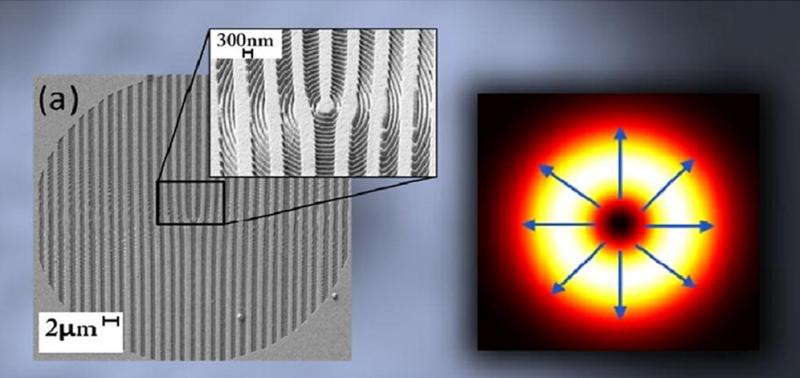
Leftholographic component fabricated by ion milling with a focused ion beam a 150-nanometer-thick gold film deposited on a glass substrate. A laser beam is partially transformed into a radially polarized beam as it traverses the device. The wide grooves create the donut-shaped intensity profile, known as a vortex, while the sub-wavelength nanometer grooves in the inset determine locally the radial polarization, which is perpendicular to the grooves. Right: The computed characteristic beam cross-section; the blue arrows indicate the radial polarization. (Image courtesy of Federico Capasso.)

Using these novel nanostructured holograms, the Harvard researchers have converted conventional, circularly polarized laser light into radially polarized beams at wavelengths spanning the technologically important visible and near-infrared light spectrum.
“When light is radially polarized, its electromagnetic vibrations oscillate inward and outward from the center of the beam like the spokes of a wheel,” explains Capasso. “This unusual beam manifests itself as a very intense ring of light with a dark spot in the center.”
“It is noteworthy,” Capasso points out, “that the same nanostructured holographic plate can be used to create radially polarized light at so many different wavelengths. Radially polarized light can be focused much more tightly than conventionally polarized light, thus enabling many potential applications in microscopy and nanoparticle manipulation.”
The new device resembles a normal hologram grating with an additional, nanostructured pattern carved into it. Visible light, which has a wavelength in the hundreds of nanometers, interacts differently with apertures textured on the ‘nano’ scale than with those on the scale of micrometers or larger. By exploiting these behaviors, the modular interface can bend incoming light to adjust its intensity, phase, and polarization.
Holograms, beyond being a staple of science-fiction universes, find many applications in security, like the holographic panels on credit cards and passports, and new digital hologram-based data-storage methods are currently being designed to potentially replace current systems. Achieving fine-tuned control of light is critical to advancing these technologies.
“Now, you can control everything you need with just a single interface,” says Genevet, pointing out that the polarization effect the new interface has on light could formerly only be achieved by a cascade of several different optical elements. “We’re gaining a big advantage in terms of saving space.”
The demonstration of this nanostructured hologram has become possible only recently with the development of more powerful software and higher resolution nanofabrication technologies.
The underlying design is more complex than a simple superposition of nanostructures onto the hologram. The phase and polarization of light closely interact, so the structures must be designed with both outcomes in mind, using modern computational tools.
Further research will aim to make more complex polarized holograms and to optimize the output efficiency of the device.
Genevet’s and Capasso’s collaborators included co-lead author Jiao Lin, a former SEAS postdoctoral fellow who is now at the Singapore Institute of Manufacturing Technology; Mikhail Kats, a graduate student at Harvard SEAS; and Nicholas Antoniou, principal focused ion beam engineer at the Center for Nanoscale Systems at Harvard University.
This research was supported in part by the Air Force Office of Scientific Research (FA9550-12-1-0289); the National Science Foundation (NSF), through a Graduate Research Fellowship; and the Agency for Science, Technology and Research (A*STAR) in Singapore. Device fabrication was carried out at the Center for Nanoscale Systems at Harvard University, which is a member of the NSF-supported National Nanotechnology Infrastructure Network (ECS-0335765).

Friday, August 16, 2013

New Twist in the Graphene Story: « Berkeley Lab News Center

Researchers with the U.S. Department of Energy (DOE)’s Lawrence Berkeley National Laboratory (Berkeley Lab) have discovered a unique new twist to the story of graphene, sheets of phttp://newscenter.lbl.gov/feature-stories/2013/08/12/new-twist-in-the-graphene-story/ure carbon just one atom thick, and in the process appear to have solved a mystery that has held back device development.
Electrons can race through graphene at nearly the speed of light – 100 times faster than they move through silicon. In addition to being superthin and superfast when it comes to conducting electrons, graphene is also superstrong and superflexible, making it a potential superstar material in the electronics and photonics fields, the basis for a host of devices, starting with ultrafast transistors. One big problem, however, has been that graphene’s electron  conduction can’t be completely stopped, an essential requirement for on/off devices.
The on/off problem stems from monolayers of graphene having no bandgaps – ranges of energy in which no electron states can exist. Without a bandgap, there is no way to control or modulate electron current and therefore no way to fully realize the enormous promise of graphene in electronic and photonic devices. Berkeley Lab researchers have been able to engineer precisely controlled bandgaps in bilayer graphene through the application of an external electric field. However, when devices were made with these engineered bandgaps, the devices behaved strangely, as if conduction in those bandgaps had not been stopped. Why such devices did not pan out has been a scientific mystery until now.

“The introduction of the twist generates a completely new electronic structure in the bilayer graphene that produces massive and massless Dirac fermions,” says Bostwick. “The massless Dirac fermion branch produced by this new structure prevents bilayer graphene from becoming fully insulating even under a very strong electric field. This explains why bilayer graphene has not lived up to theoretical predictions in actual devices that were based on perfect or untwisted bilayer graphene.”
Bostwick is the corresponding author of a paper describing this research in the journal Nature Materialstitled “Coexisting massive and massless Dirac fermions in symmetry-broken bilayer graphene.” Keun Su Kim of the Fritz Haber Institute in Berlin is the lead author Other coauthors are Andrew Walter, Luca Moreschini, Thomas Seyller, Karsten Horn and Eli Rotenberg, who oversees the research at ALS Beamline 7.0.1.

Rotenberg, Bostwick, Kim and their co-authors tackled the bilayer graphene mystery by performing a series of angle-resolved photoemission spectroscopy (ARPES) experiments at ALS beamline 7.0.1. ARPES is a technique for studying the electronic states of a solid material in which a beam of X-ray photons striking the material’s surface causes the photoemission of electrons. The kinetic energy of these photoelectrons and the angles at which they are ejected are then measured to obtain an electronic spectrum.

“The combination of ARPES and Beamline 7.0.1 enabled us to easily identify the electronic spectrum from the twist in the bilayer graphene,” says Rotenberg. “The spectrum we observed was very different from what has been assumed and contains extra branches consisting of massless Dirac fermions.  These new massless Dirac fermions move in a completely unexpected way governed by the symmetry twisted layers.”
Massless Dirac fermions, electrons that essentially behave as if they were photons, are not subject to the same bandgap constraints as conventional electrons. In their Nature Materials paper, the authors state that the twists that generate this massless Dirac fermion spectrum may be nearly inevitable in the making of bilayer graphene and can be introduced as a result of only ten atomic misfits in a square micron of bilayer graphene.
“Now that we understand the problem, we can search for solutions,” says lead author Kim. “For example, we can try to develop fabrication techniques that minimize the twist effects, or reduce the size of the bilayer graphene we make so that we have a better chance of producing locally pure material.”
Beyond solving a bilayer graphene mystery, Kim and his colleagues say the discovery of the twist establishes a new framework on which various fundamental properties of bilayer graphene can be more accurately predicted.
“A lesson learned here is that even such a tiny structural distortion of atomic-scale materials should not be dismissed in describing the electronic properties of these materials fully and accurately,” Kim says.
This research was supported by the DOE Office of Science.
# # #
Lawrence Berkeley National Laboratory addresses the world’s most urgent scientific challenges by advancing sustainable energy, protecting human health, creating new materials, and revealing the origin and fate of the universe. Founded in 1931, Berkeley Lab’s scientific expertise has been recognized with 13 Nobel prizes. The University of California manages Berkeley Lab for the U.S. Department of Energy’s Office of Science. For more, visit www.lbl.gov.
The DOE Office of Science is the single largest supporter of basic research in the physical sciences in the United States and is working to address some of the most pressing challenges of our time. For more information, please visit science.energy.gov.
The Advanced Light Source is a third-generation synchrotron light source producing light in the x-ray region of the spectrum that is a billion times brighter than the sun. A DOE national user facility, the ALS attracts scientists from around the world and supports its users in doing outstanding science in a safe environment. For more information visit www-als.lbl.gov/.The Advanced Light Source is a third-generation synchrotron light source producing light in the x-ray region of the spectrum that is a billion times brighter than the sun. A DOE national user facility, the ALS attracts scientists from around the world and supports its users in doing outstanding science in a safe environment. For more information visit http://www.als.lbl.gov/.