The mission of the NWA is to globally promote nanotechnology solutions adoption across industries by connecting entrepreneurs with researchers, start-ups with investors, providers with potential customers, employers with job seekers, key players with one another, in an independent and mainly industry-oriented advocacy group – inclusive of business, academia, business-supporting associates, as well as affiliate government agencies and other associations.
Peering at the debris from particle collisions that recreate the conditions of the very early universe, scientists have for the first time measured the force of interaction between pairs of antiprotons. Like the force that holds ordinary protons together within the nuclei of atoms, the force between antiprotons is attractive and strong.
The experiments were conducted at the Relativistic Heavy Ion Collider (RHIC), a U.S. Department of Energy Office of Science User Facility for nuclear physics research at DOE's Brookhaven National Laboratory. The findings, published in the journal Nature, could offer insight into larger chunks of antimatter,including antimatter nuclei previously detected at RHIC, and may also help scientists explore one of science's biggest questions: why the universe today consists mainly of ordinary matter with virtually no antimatter to be found.
"The Big Bang—the beginning of the universe—produced matter and antimatter in equal amounts. But that's not the world we see today. Antimatter is extremely rare. It's a huge mystery!" said Aihong Tang, a Brookhaven physicist involved in the analysis, which used data collected by RHIC's STAR detector. "Although this puzzle has been known for decades and little clues have emerged, it remains one of the big challenges of science. Anything we learn about the nature of antimatter can potentially contribute to solving this puzzle."
RHIC is the perfect place to study antimatter because it's one of the few places on Earth that is able to create the elusive stuff in abundant quantities.
RHIC is the perfect place to study antimatter because it's one of the few places on Earth that is able to create the elusive stuff in abundant quantities. It does this by slamming the nuclei of heavy atoms such as gold into one another at nearly the speed of light. These collisions produce conditions very similar to those that filled the universe microseconds after the Big Bang—with temperatures 250,000 times hotter than the center of the sun in a speck the size of a single atomic nucleus. All that energy packed into such a tiny space creates a plasma of matter's fundamental building blocks, quarks and gluons, and thousands of new particles—matter and antimatter in equal amounts.
"We are taking advantage of the ability to produce ample amounts of antimatter so we can conduct this study," said Tang.
The STAR collaboration has previous experience detecting and studying rare forms of antimatter—including anti-alpha particles, the largest antimatter nuclei ever created in a laboratory, each made of two antiprotons and two antineutrons. Those experiments gave them some insight into how the antiprotons interact within these larger composite objects. But in that case, "the force between the antiprotons is a convolution of the interactions with all the other particles," Tang said. "We wanted to study the simple interaction of unbound antiprotons to get a 'cleaner' view of this force."
To do that, they searched the STAR data from gold-gold collisions for pairs of antiprotons that were close enough to interact as they emerged from the fireball of the original collision.
"We see lots of protons, the basic building blocks of conventional atoms, coming out, and we see almost equal numbers of antiprotons," said Zhengqiao Zhang, a graduate student in Professor Yu-Gang Ma's group from the Shanghai Institute of Applied Physics of the Chinese Academy of Sciences, who works under the guidance of Tang when at Brookhaven. "The antiprotons look just like familiar protons, but because they are antimatter, they have a negative charge instead of positive, so they curve the opposite way in the magnetic field of the detector."
"By looking at those that strike near one another on the detector, we can measure correlations in certain properties that give us insight into the force between pairs of antiprotons, including its strength and the range over which it acts," he added.
The scientists found that the force between antiproton pairs is attractive, just like the strong nuclear force that holds ordinary atoms together. Considering they'd already discovered bound states of antiprotons and antineutrons—those antimatter nuclei—this wasn't all that surprising. When the antiprotons are close together, the strong force interaction overcomes the tendency of the like (negatively) charged particles to repel one another in the same way it allows positively charged protons to bind to one another within the nuclei of ordinary atoms.
In fact, the measurements show no difference between matter and antimatter in the way the strong force behaves. That is, within the accuracy of these measurements, matter and antimatter appear to be perfectly symmetric. That means, at least with the precision the scientists were able to achieve, there doesn't appear to be some asymmetric quirk of the strong force that can account for the continuing existence of matter in the universe and the scarcity of antimatter today.
But the scientists point out that we wouldn't know that if they hadn't done these experiments.
"There are many ways to test for matter/antimatter asymmetry, and there are more precise tests, but in addition to precision, it's important to test it in qualitatively different ways. This experiment was a qualitatively new test," said Richard Lednický, a STAR scientist from the Joint Institute for Nuclear Research, Dubna, and the Institute of Physics, Czech Academy of Sciences, Prague.
"The successful implementation of the technique used in this analysis opens an exciting possibility for exploring details of the strong interaction between other abundantly produced particle species," he said, noting that RHIC and the Large Hadron Collider (LHC) are ideally suited for these measurements, which are difficult to assess by other means.
Scientists at TU Wien (Vienna) have calculated that the meson f0(1710) could be a very special particle – the long-sought-after glueball, a particle composed of pure force.
For decades, scientists have been looking for so-called “glueballs”. Now it seems they have been found at last. A glueball is an exotic particle, made up entirely of gluons – the “sticky” particles that keep nuclear particles together. Glueballs are unstable and can only be detected indirectly, by analysing their decay. This decay process, however, is not yet fully understood.
Professor Anton Rebhan and Frederic Brünner from TU Wien (Vienna) have now employed a new theoretical approach to calculate glueball decay. Their results agree extremely well with data from particle accelerator experiments. This is strong evidence that a resonance called “f0(1710)”, which has been found in various experiments, is in fact the long-sought glueball. Further experimental results are to be expected in the next few months.
Forces are Particles too
Protons and neutrons consist of even smaller elementary particles called quarks. These quarks are bound together by strong nuclear force. “In particle physics, every force is mediated by a special kind of force particle, and the force particle of the strong nuclear force is the gluon”, says Anton Rebhan (TU Wien).
Gluons can be seen as more complicated versions of the photon. The massless photons are responsible for the forces of electromagnetism, while eight different kinds of gluons play a similar role for the strong nuclear force. However, there is one important difference: gluons themselves are subject to their own force, photons are not. This is why there are no bound states of photons, but a particle that consists only of bound gluons, of pure nuclear force, is in fact possible.
In 1972, shortly after the theory of quarks and gluons was formulated, the physicists Murray Gell-Mann and Harald Fritsch speculated about possible bound states of pure gluons (originally called “gluonium”, today the term “glueball” is used). Several particles have been found in particle accelerator experiments which are considered to be viable candidates for glueballs, but there has never been a scientific consensus on whether or not one of these signals could in fact be the mysterious particle made of pure force. Instead of a glueball, the signals found in the experiments could also be a combination of quarks and antiquarks. Glueballs are too short-lived to detect them directly. If they exist, they have to be identified by studying their decay.
Candidate f0(1710) decays strangely
“Unfortunately, the decay pattern of glueballs cannot be calculated rigorously”, says Anton Rebhan. Simplified model calculations have shown that there are two realistic candidates for glueballs: the mesons called f0(1500) and f0(1710). For a long time, the former was considered to be the most promising candidate. The latter has a higher mass, which agrees better with computer simulations, but when it decays, it produces many heavy quarks (the so-called “strange quarks”). To many particle scientists, this seemed implausible, because gluon interactions do not usually differentiate between heavier and lighter quarks.
Anton Rebhan and his PhD-student Frederic Brünner have now made a major step forward in solving this puzzle by trying a different approach. There are fundamental connections between quantum theories describing the behaviour of particles in our three dimensional world and certain kinds of gravitation theories in higher dimensional spaces. This means that certain quantum physical questions can be answered using tools from gravitational physics.
“Our calculations show that it is indeed possible for glueballs to decay predominantly into strange quarks”, says Anton Rebhan. Surprisingly, the calculated decay pattern into two lighter particles agrees extremely well with the decay pattern measured for f0(1710). In addition to that, other decays into more than two particles are possible. Their decay rates have been calculated too.
Further Data is Expected Soon
Up until now, these alternative glueball decays have not been measured, but within the next few months, two experiments at the Large Hadron Collider at CERN (TOTEM and LHCb) and one accelerator experiment in Beijing (BESIII) are expected to yield new data. “These results will be crucial for our theory”, says Anton Rebhan. “For these multi-particle processes, our theory predicts decay rates which are quite different from the predictions of other, simpler models. If the measurements agree with our calculations, this will be a remarkable success for our approach.” It would be overwhelming evidence for f0(1710) being a glueball. And in addition to that, it would once again show that higher dimensional gravity can be used to answer questions from particle physics – in a way it would be one more big success of Einstein’s theory of general relativity, which turns 100 years old next month.
In a stringent test of a fundamental property of the standard model of particle physics, known as CPT symmetry, researchers from the RIKEN-led BASE collaboration at CERN have made the most precise measurements so far of the charge-to-mass ratio of protons and their antimatter counterparts, antiprotons. The work, published in Nature, was carried out using CERN’s Antiproton Decelerator, a device that provides low-energy antiprotons for antimatter studies.
CPT invariance—which the experiment was meant to test—means that a system remains unchanged if three fundamental properties are reversed—C (charge), which distinguishes matter from antimatter, P (parity), which implies a 180 degree flip in space, and T (time). It is a central tenet of the standard model, and implies that antimatter particles must be perfect mirror images of matter, with only their charges reversed.
"This is an important issue," says Stefan Ulmer, who led the research, "because it helps us to understand why we live in a universe that has practically no antimatter, despite the fact that the Big Bang must have led to the creation of both. If we had found violations of CPT, it would mean that matter and antimatter might have different properties—for example that antiprotons might decay faster than protons—but we have found within quite strict limits that the charge-to-mass ratios are the same."
To perform the research, the team used a scheme similar to that developed by the TRAP collaboration in the 1990s. They received antiprotons and negative hydrogen ions—as a proxy for protons—from the Antiproton Decelerator, and then trapped single antiproton-hydrogen ion pairs in a magnetic Penning trap, decelerating them to ultra-low energies. They then measured the cyclotron frequency of the pairs—a measurement that allows scientists to determine the charge-to-mass ratio—and compared them to find how similar they were. In total, they measured approximately 6,500 pairs over a 35-day period.
"What we found," says Ulmer, "is that the charge-to-mass ratio is identical to within just 69 parts per trillion." This measurement has four times higher energy resolution than previous measurements of proton-antiproton pairs, and further constrains the possibility of violations of CPT invariance. "Ultimately," he says, "we plan to achieve measurements that are at least ten or a hundred times more precise than the current standard."
The work also has implications for what is known as the weak equivalence principle—the idea that all particles will be affected by gravity in the same way, regardless of their mass and charge. The team used their findings to calculate that within about one part per million, antimatter and matter behave in the same way with respect to gravity.
According to BASE member Christian Smorra, "There are many reasons to believe in physics beyond the standard model, including the mystery of dark matter and, of course, the imbalance between matter and antimatter. These high-precision measurements put important new constraints and will help us to determine the direction of future research."
The study was done by the BASE collaboration, which includes researchers from RIKEN, CERN, the Max Planck Institute for Nuclear Physics, The University of Tokyo, Johannes Gutenberg University, GSI Helmholtz Centre for Heavy Ion Research, and Helmholtz Institute Mainz.
Tiny Drops of Hot Quark Soup—How Small Can They Be?
New analyses of deuteron-gold collisions at RHIC reveal that even small particles can create big surprises
Scientists designed and built the Relativistic Heavy Ion Collider (RHIC) at the U.S. Department of Energy’s Brookhaven National Laboratory to create and study a form of matter that last existed a fraction of a second after the Big Bang, some 13.8 billion years ago. The early-universe matter is created when two beams of gold nuclei traveling close to the speed of light slam into one another. The high-speed particle smashups pack so much energy into such a tiny space that the hundreds of protons and neutrons making up the nuclei “melt” and release their constituent particles—quarks and gluons—so scientists can study these building blocks of matter as they existed at the dawn of time.
Collisions between gold nuclei and deuterons—much smaller particles made of just one proton and one neutron—weren’t supposed to create this superhot subatomic soup known as quark-gluon plasma (QGP). They were designed as a control experiment, to generate data to compare against RHIC’s gold-gold smashups. But new analyses indicate that these smaller particle impacts may be serving up miniscule servings of hot QGP—a finding consistent with similar results from Europe’s Large Hadron Collider (LHC), which can also collide heavy nuclei.
“Considering that the quark-gluon plasma we create in gold-gold collisions at RHIC fills a space that is approximately the size of the nucleus of a single gold atom, the possible hot spots we’re talking about in these deuteron-gold collisions are much, much smaller—and an intriguing surprise,” said Dave Morrison, a physicist at Brookhaven and co-spokesperson for RHIC’s PHENIX collaboration. The collaboration describes their results in two papers just published by Physical Review Letters, one of which is highlighted by the journal.
The findings at RHIC and the LHC have triggered active debate about their interpretation. Said PHENIX co-spokesperson Jamie Nagle of the University of Colorado, “There isn't yet universal agreement about what we’re seeing in these small systems, but if indeed nearly perfect fluid droplets of quark-gluon plasma are being formed, this may be a perfect testing ground for understanding the essential conditions for creating this remarkable state of matter.”
New analyses
The PHENIX scientists’ evidence for the possibility of tiny hot spots comes from taking a closer look at data collected by their namesake detector, one of two large particle trackers at RHIC, during deuteron-gold collisions in 2008. The group was inspired to conduct a new analysis after hints of QGP-like behavior emerged from similar control experiments in the heavy-ion physics program at the LHC.
When not searching for particles such as the Higgs boson, the LHC spends a few weeks during each experimental run colliding beams of lead nuclei to create and study QGP at higher energies than RHIC, using protons instead of deuterons for its control experiments. In those control collisions (between lead nuclei with protons and also in some collisions of protons with protons), LHC scientists observed certain “signatures” that were surprisingly reminiscent of those generated by QGP—namely similar patterns of particle production and correlations in how particles flow out of the collisions.
When PHENIX physicists took a closer look at their data from deuteron-gold collisions at RHIC, they saw the same telltale effects.
Correlations in particle “flow”
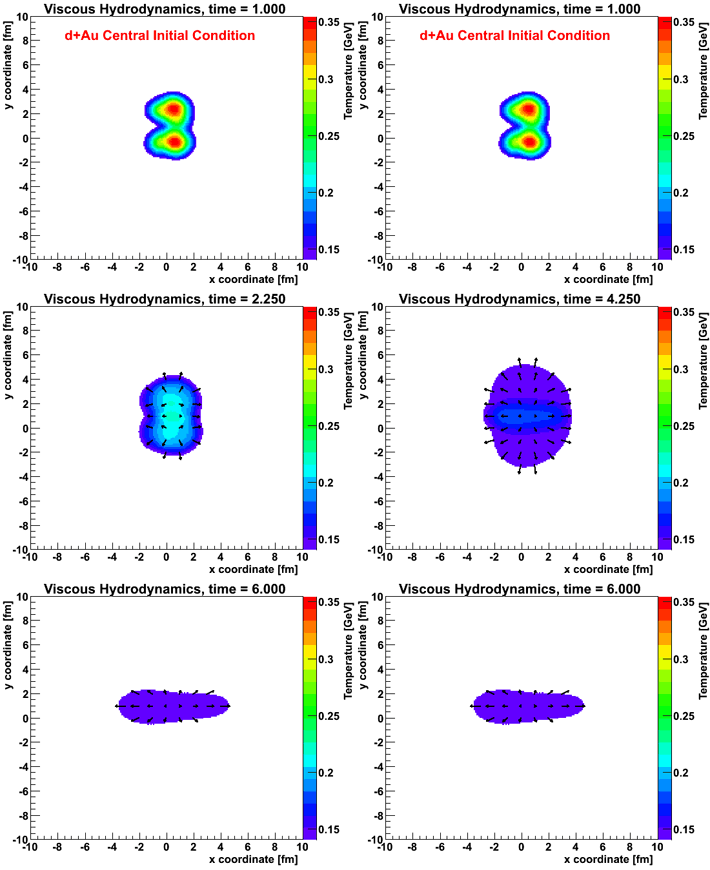
This animation shows how hot spots (red) created in a deuteron-gold collision—formed from the impact of the deuteron's proton and neutron with the gold nucleus—evolve into cooler matter that flows out to the sides. This small scale flow is similar to the dramatic elliptical particle flow observed in gold-gold collisions at RHIC. Credit: Produced using the viscous hydrodynamic code of Prof. Paul Romatschke (University of Colorado) run by Jamie Nagle and Mike McCumber.
“As you look around the collision and measure the particles detected at different angles, it’s not just a random array of particles coming out. There are strong correlations among some of the particles,” Morrison said. For example, if a particle emerges in one direction, you are more likely to see a “correlated” particle emerging in a particular, predictable direction (for example, back-to-back or alongside one another), rather than in random directions.
These correlations produce an asymmetric distribution of particles as they expand from the collision zone, with more particles flowing out in an elliptically shaped area close to the plane of the colliding beams than perpendicular to it. This elliptical flow pattern is one of the defining characteristics of the quark-gluon plasma created in gold-gold collisions at RHIC.
Evidence to date suggests that gold-gold collisions the Relativistic Heavy Ion Collider at Brookhaven are indeed creating a new state of hot, dense matter, but one quite different and even more remarkable than had been predicted. Instead of behaving like a gas of free quarks and gluons, as was expected, the matter created in RHIC's heavy ion collisions appears to be more like a "perfect" liquid.
“In the relatively big drop of quark-gluon plasma created in gold-gold collisions, which flows like a friction-free ‘perfect’ liquid, there’s all sorts of collective motion that gives you that pattern. But it was not expected to see this in these smaller systems,” he said.
The strength of these particle correlations in deuteron-gold collisions increases the higher the momentum of the particles, said Brookhaven/PHENIX physicist Anne Sickles, who led the group analyzing and writing up the flow results. That pattern fits the models of “hydrodynamic” flow used to describe the behavior of hot QGP. “Even though the system—the hot spot created in these deuteron-gold collisions—is very small, it shows particle correlations similar to those understood to be triggered by flow in much larger collisions of gold on gold,” Sickles said.
If signs of flow persist to higher levels of correlations—for example, producing flow patterns with three or more lobes instead of simple ellipses—it would be a clear sign that the deuteron is somehow altering the state of the tiny portion of the gold nucleus with which it interacts. Data from the LHC have already revealed some evidence for these higher-level correlations. Future runs colliding deuterons, protons, or helium nuclei with gold at RHIC have the potential to provide the definitive test by changing the shape of the initial hot spot and looking for corresponding changes in particle correlation patterns.
Differential dips in particles counted
Other intriguing findings emerged when PHENIX physicists looked at the relative numbers of particles containing “charm” and “anticharm” quarks counted in RHIC’s various collisions. Charm and anticharm quarks don’t exist in ordinary matter, so all the charm and anticharm particles picked up by RHIC’s detectors are created in the collisions. But there are several ways these particles and their antiparticles can combine, with the charm and anticharm particles in one arrangement (J/psi particles) being more tightly bound together than in others (e.g. psi prime). Counting the numbers of the different combinations emerging from different types of collisions could offer clues about what’s happening inside.
For example, PHENIX scientists compared the numbers of J/psi and psi prime particles counted by their detector in glancing deuteron-gold collisions—where the smaller deuteron just nicks the edge of the big gold nucleus—with those emerging from more central collisions—where the deuteron pierces the center of the gold nucleus.
The glancing collisions produced results very similar to those from proton-proton collisions. “It was as if the deuteron was colliding with a single proton at the edge of the gold nucleus,” said Darren McGlinchey of the University of Colorado, who led the group that wrote the paper on these results.
In the central collisions, however, where the deuteron interacts with more protons and neutrons inside the nucleus, the detectors counted fewer of both types of charm-anticharm particles than would be expected from these multiple interactions. Additionally, the number of the less-tightly bound charm-anticharm pairs (the psi primeparticles) was suppressed more than the tightly bound J/psi’s—and this difference got bigger the more central the collisions were.
“This differential particle suppression suggests that something novel is going on in the more central deuteron-gold collisions,” McGlinchey said.
Is it something that happens in the collision—perhaps interactions of the particles with tiny specks of quark-gluon plasma, causing them to lose energy and get “stuck” as happens in the big drops of QGP formed in gold-gold collisions? Or is it due to some characteristic of the bigger nucleus that exists before the collision even takes place?
That question of before or after—which physicists refer to as initial state vs. final state effects—is a big part of the debate going on right now about these findings from both RHIC and the LHC.
Other explanations
Some theorists, for example, suggest that the correlations in particle flow patterns observed in deuteron-gold and proton-lead collisions could be triggered not by tiny specks of hot quark-gluon plasma, but instead by properties of the “cold” nuclei themselves. These nuclei, they say, reveal a different aspect of their identity when moving close to the speed of light.
Their evidence comes from experiments at other colliders revealing that the quarks and gluons making up protons and neutrons are far from static. They constantly move about and even blink in and out of existence, forming new particles and disappearing like fireflies blinking on and off in the evening sky—with the gluons, in particular, proliferating profusely to the point where they dominate the nuclei.
Because light speed motion stretches time, it effectively freezes this action so the fast moving nuclei appear as dense walls of gluons, called color glass condensates, which are thicker in the center of the speeding nuclei than near their edges. These variations in the distribution of gluons within the nuclei might account for some of the unusual signs observed when smaller particles like deuterons or protons collide with the nuclei. The gluon walls may even play a role in the formation of “large” scale quark-gluon plasma in nucleus-nucleus collisions.
Next steps
Separating the initial state effects from the final state effects is important if scientists want to fully understand the subtle details of the big drops of QGP created at RHIC and the LHC.
“In gold-gold collisions, there are initial state effects and final state effects but they are entangled,” said Morrison. “In deuteron-gold, there are still initial and final state effects, but you would expect initial state effects to be more important than final state ones in the smaller system—because even if you are making tiny drops of quark-gluon plasma, the bulk of the nucleus still exists in its initial state. These deuteron-gold collisions are therefore still valid control experiments for comparison with gold-gold.” Comparing proton-lead collisions at the LHC with RHIC’s existing deuteron-gold collisions—as well as possible future deuteron-gold, proton-gold, and helium-gold collisions—may provide an extra handle that highlights RHIC’s unique versatility.
Another way to disentangle the roles played by conditions before and after the collisions would be to probe the light-speed nuclei with extreme precision using a beam of accelerated electrons. Brookhaven Lab has a vision for transforming RHIC into a machine with that capability—known as an electron ion collider—by adding an electron accelerator ring to the existing RHIC infrastructure sometime in the 2020s. The new facility would be called eRHIC.
“Using electrons and small nuclei such as protons, deuterons, and helium to probe the larger, heavy nuclei are complementary ways to get a complete picture of what’s going on inside the nucleus,” said Nagle. That glimpse of the inner workings of atomic nuclei will help scientists better understand the quark gluon plasma—and possibly how that primordial soup ultimately gave rise to the bulk of visible matter in today’s world.