Showing posts with label optomechanics. Show all posts

Monday, August 10, 2015

Measuring the smallest vibration


absolute zero. This required building a sensor capable of resolving the smallest vibration allowed by quantum mechanics.

Quantum mechanics predicts that a mechanical object, even when cooled to absolute zero, produces small vibrations, called “zero-point fluctuations”. The reason we don’t observe these vibrations in everyday life is that for a tangibly sized object at room temperature, they are much smaller than the vibrations caused by thermal motion of atoms. EPFL researchers have overcome this challenge by coupling a micrometer-sized glass string to a very precise, optical displacement sensor. The sensor is so precise that it can, in principle, resolve the string’s zero-point fluctuations before they are obscured by thermal vibrations. Combining this low-noise readout with a feedback force, the scientists were able to suppress the string’s thermal vibrations to a magnitude only 10 times larger than their zero-point value – in effect realizing an extreme version of a noise cancellation headphone. The work is published in Nature.

Feedback at the quantum limit

Feedback is a ubiquitous tool in modern engineering, used in applications ranging from cruise control to atomic clocks. The basic paradigm uses a sensor to monitor the state of a system (e.g. a car's velocity) and an actuator (e.g. an engine throttle) to steer the system along a desired path (e.g. within the ed limit).

As sensor technology advances, it has been proposed to use such "feedback control" to prepare and stabilize delicate quantum states – for instance, the celebrated half-living, half-dead state of Schrodinger's Cat. Aside from their fundamental interest, the ability to cultivate quantum states is expected to play a crucial role in future technologies such as quantum computers.

The main challenge to quantum feedback control is something called "decoherence", which dictates that the behavior of a system in a quantum state is rapidly destroyed by its interaction with the thermal environment. This places stringent requirements on the speed and precision of the sensor. Successful demonstrations have therefore been limited to a small subset of well-isolated systems, like individual trapped atoms, photons, and superconducting circuits.

Shedding light on the problem

The lab of Tobias J. Kippenberg at EPFL has fabricated an extremely precise optical position sensor that may – surprisingly – extend quantum feedback control to engineered mechanical devices . In the "blink of an eye" (0.3 - 0.4 seconds) the sensor is capable of resolving a displacement 100 times smaller than the size of a proton. Making use of such a high-speed sensor, it is possible to capture an image in which the blur (or uncertainty) of an object's position is smaller than the uncertainty caused by the thermal motion of its constituent atoms.

Using a continuous stream of such "freeze frames", the researchers have used feedback to reduce the motion of a mechanical device – in this case the vibration of a micron-sized, glass string – to the value it would have if the device were cooled 0.001 degrees above absolute zero. The residual vibration of the string is only 10 times bigger than the minimum (``zero-point”) value allowed by quantum mechanics. This means that the string spends 10% of its time in its quantum “ground state.”

Kippenberg’s lab specializes in the field of “cavity optomechanics”. In optomechanics, much like in high-speed photography, the motion of a mechanical device is imaged using an intense beam of light. The challenge in this case was to focus the light into a very small spot, in order to maximize its interaction with the tiny string.

The researchers achieved this by confining the light and the string to a miniature “hall of mirrors” called an “optical microcavity”. Developed in the Center of MicroTechnology at EPFL, the optical microcavity is a small, disk-shaped piece of glass, above which the string is suspended by 50 nm. Laser light coupled into the disk circulates along its periphery ~10,000 times, each time reflecting off the string and incurring a small delay in proportion to the string’s vibration amplitude. This delay is measured using a technique called interferometry.

To cool the string’s vibration, the researchers took advantage of a well-known side-effect of optical measurement: namely, that each reflection of the circulating field also imparts a small force, called “radiation pressure”, on the string. Using a sequence of electronics, the researchers imprinted a measurement of the string’s vibration onto the intensity of a second laser field. As lead author Dal Wilson explains, “The radiation pressure applied by the second field, when appropriately delayed, exactly opposes the thermal motion of the string, like a noise-cancellation headphone”.

http://www.nanotechnologyworld.org/#!Measuring-the-smallest-vibration/c89r/55c8cde20cf2244af607fa2e
Thursday, March 6, 2014

Ultra sensitive detection of radio waves with lasers

Radio waves are used for many measurements and applications, for example, in communication with mobile phones, MRI scans, scientific experiments and cosmic observations. But ‘noise’ in the detector of the measuring instrument limits how sensitive and precise the measurements can be. Now researchers at the Niels Bohr Institute have developed a new method where they can avoid noise by means of laser light and can therefore achieve extreme precision of measurements. The results are published in the prestigious scientific journal, Nature.
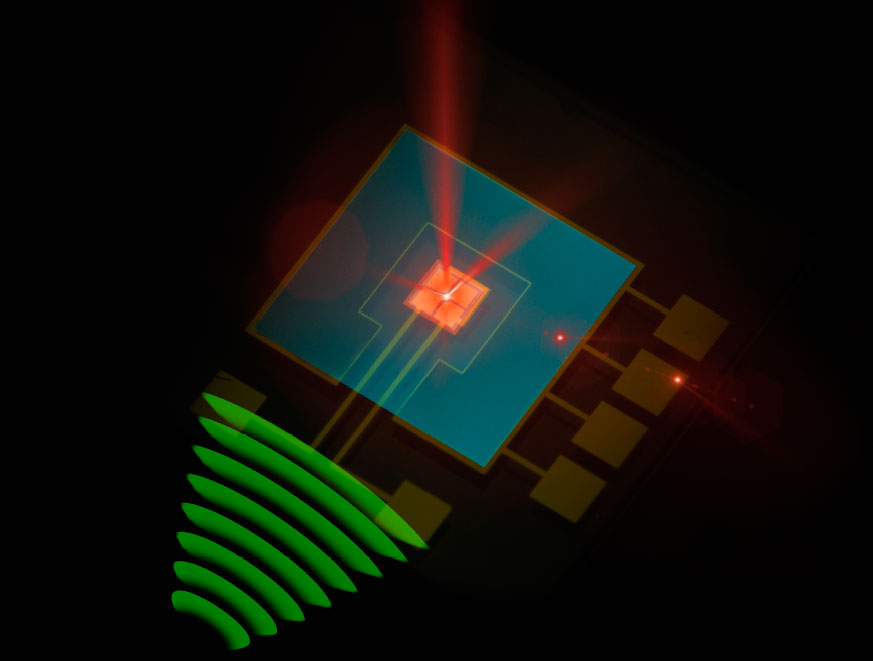
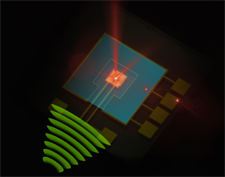
The method, called optomechanics, is a complex interaction between a mechanical movement and optical radiation. The laser light has almost no noise, as all its photons are identical. In this way, the special properties of the nanomembrane are fully exploited. (Artists impression by Mette Høst)
‘Noise’ in the detector of a measuring instrument is first and foremost due to heat, that causes atoms and electrons to move chaotically, so the measurements become imprecise. The usual method to reduce noise in the detector of the measuring equipment is therefore to cool it down to 5-10 degrees Kelvin, which corresponds to approx. minus 265 degrees C. This is expensive and stille does not allow to measure the weakest signals.
“We have developed a detector that does not need to be cooled down, but which can operate at room temperature and yet hardly has any thermal noise. The only noise that fundamentally remains is so-called quantum noise, which is the minimal fluctuations of the laser light itself,” explains Eugene Polzik, Professor and Head of the research center Quantop at the Niels Bohr Institute at the University of Copenhagen.

Optomechanical method

The method, called optomechanics, is a complex interaction between a mechanical movement and optical radiation.
The experiment consists of an antenna, which picks up the radio waves, a capacitor and a laser beam. The antenna picks up the radio waves and transfers the signal to the capacitor, which is read by the laser beam - that is to say the capacitor and the laser beam make up the detector. But the capacitor is not an ordinary pair of metal plates.
The nanomembrane itself is made of silicon nitrate and is coated with a thin layer of aluminum, since there has to be a metallic substance to better interact with the electric field. The membrane is separated from the surroundings by being enclosed in a vacuum chamber so that it responds as if it had been cooled down to two degrees Kelvin (minus 271 C).
“In our system, one metal plate in the capacitor is replaced by a 50 nanometer thick membrane (a nanometer is a millionth of a millimeter). It is this nanomembrane that allows us to make ultrasensitive measurements without cooling the system, explains Research Assistant Professor Albert Schliesser, who has coordinated the the experiments in Quantop’s optomechanical laboratory at the Niels Bohr Institute.
He explains that the capacitor is made up of three layers. At the bottom is a chip made of glass with a layer of aluminum, where the positive and negative poles are. The nanomembrane itself is made of silicon nitrate and is coated with a thin layer of aluminum, since there has to be a metallic substance to better interact with the electric field. The chip and the membrane are only separated by a micrometer.
The radio wave signal produces fluctuations in the membrane and you can now read the signal optically using a laser beam. This is done through a complex interaction between the membrane’s mechanical fluctuations, the electrical properties of the metallic layer and the light that is hitting the membrane.
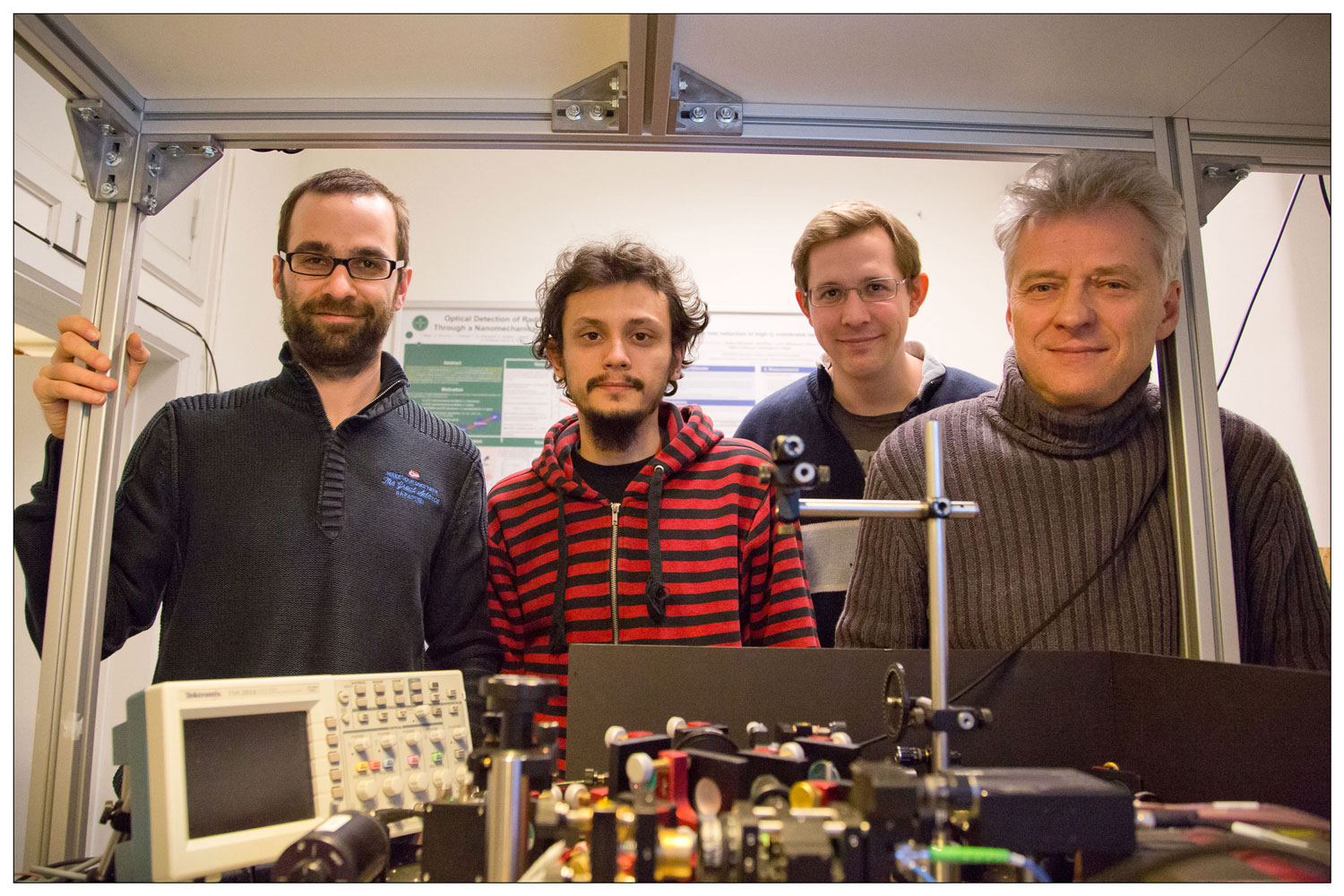
The experiments are carried out here at the Quantop laboratories at the Niels Bohr Institute. The research group consists of Research Assistant Professor Albert Schliesser, PhD students Tolga Bagci and Anders Simonsen and Professor Eugene Polzik.
The method was developed by Eugene Polzik and Albert Schliesser in collaboration with the theoretical quantum optics groups at the Niels Bohr Institute and the Joint Quantum Institute in Maryland, USA. The electromechanical chip was developed at Nanotech, DTU.

Ultrasensitive measurements

This optomechanical method has three types of noise: Electrical noise in the antenna, mechanical thermal noise in the membrane and quantum noise of the light. The electrical noise is technical and is mostly due to disturbances from the environment.
“This has been a technical challenge and the two PhD students Tolga Bagci and Anders Simonsen have worked days and nights to solve the problem. The solution has been to find just the right way to shield the experiment,” says Albert Schliesser.  
The two PhD students Tolga Bagci and Anders Simonsen have worked days and nights to solve the problem with noise due to disturbances from the environment. The solution has been to find just the right way to shield the experiment.
Everything takes place at normal room temperature and yet there is almost no mechanical ‘thermal noise’. This is surprising and is due to several factors - including the membrane’s extremely high mechanical properties and that the membrane is separated from the surroundings by being enclosed in a vacuum chamber so that it responds as if it had been cooled down to two degrees Kelvin (minus 271 C). 
The laser light has almost no noise, as all its photons are identical. In this way, the special properties of the nanomembrane are fully exploited.

Groundbreaking method

“This membrane is an extremely good oscillator and that is why it is so ultrasensitive. At room temperature, it works as effectively as if it was cooled down to minus 271 C and we are working to get it even closer to minus 273 degrees C, which is the absolute minimum. In addition, it is a huge advantage to use optical detection, as instead of using ordinary copper wires to transmit the signal, you can use fiber optic cables, where there is no energy loss,” explains Eugene Polzik.
The method was developed by Eugene Polzik and Albert Schliesser in collaboration with the theoretical quantum optics groups at the Niels Bohr Institute and the Joint Quantum Institute in Maryland, USA.
This is a groundbreaking new method for measuring electrical signals that could have a significant impact on future technologies. Eugene Polzik and Albert Schliesser see great potential in the new super sensitive method, both in equipment for medical treatment and for observations in space, where cosmologists measure radio radiation in order to study the infancy of the universe. 
Source: http://www.nbi.ku.dk/english/news/news14/ultra-sensitive-detection-of-radio-waves-with-lasers/