Showing posts with label Condensed Matter. Show all posts

Wednesday, September 30, 2015

At the edge of a quantum gas


JQI physicists observe skipping orbits in the quantum Hall regime 
JQI scientists have achieved a major milestone in simulating the dynamics of condensed-matter systems – such as the behavior of charged particles in semiconductors and other materials – through manipulation of carefully controlled quantum-mechanical models.
Going beyond their pioneering experiments in 2009 (the creation of “artificial magnetism”), the team has created a model system in which electrically neutral atoms are coaxed into performing just as electrons arrayed in a two-dimensional sheet do when they are exposed to a strong magnetic field.
The scientists then showed for the first time that it is possible to tune the model system such that the atoms (acting as electron surrogates) replicate the signature “edge state” behavior of real electrons in the quantum Hall effect (QHE), a phenomenon which forms the basis for the international standard of electrical resistance.* The researchers report their work in the 25 September issue of the journal Science.
“This whole line of research enables experiments in which charge-neutral particles behave as if they were charged particles in a magnetic field,” said JQI Fellow Ian Spielman, who heads the research team at NIST’s Physical Measurement Laboratory.
“To deepen our understanding of many-body physics or condensed-matter-like physics – where the electron has charge and many important phenomena depend on that charge – we explore experimental systems in which the components have no electrical charge, but act in ways that are functionally equivalent and can be described by the same equations,” Spielman said.
Such quantum simulators are increasingly important, as electronic components and related devices shrink to the point where their operation grows increasingly dependent on quantum-mechanical effects, and as researchers struggle to understand the fundamental physics of how charges travel through atomic lattices in superconductors or in materials of interest for eventual quantum information processing.
Quantum effects are extremely difficult to investigate at the fundamental level in conventional materials. Not only is it hard to control the numerous variables involved, but there are inevitably defects and irregularities in even carefully prepared experimental samples. Quantum simulators, however, offer precise control of system variables and yield insights into the performance of real materials as well as revealing new kinds of interacting quantum-mechanical systems.
“What we want to do is to realize systems that cannot be realized in a condensed-matter setting,” Spielman said. “There are potentially really interesting, many-body physical systems that can’t be deployed in other settings.”
To do so, the scientists created a Bose-Einstein condensate (BEC, in which ultracold atoms join in a single uniform, low-energy quantum state) of a few hundred thousand rubidium atoms and used two intersecting lasers to arrange the atoms into a lattice pattern. 

Then a second pair of lasers, each set to a slightly different wavelength, was trained on the lattice, creating "artificial magnetism" — that is, causing the electrically neutral atoms to mimic negatively charged electrons in a real applied magnetic field.
Depending on the tuning of the laser beams, the atoms were placed in one of three different quantum states representing electrons that were either in the middle of, or at opposite edges of, a two-dimensional lattice.
By adjusting the properties of the laser beams, the team produced dynamics characteristic of real materials exhibiting the QHE. Specifically, as would be expected of electrons, atoms in the bulk interior of the lattice behaved like insulators. But those at the lattice edges exhibited a distinctive "skipping"motion.
In a real QHE system, each individual electron responds to an applied magnetic field by revolving in a circular (cyclotron) orbit. In atoms near the center of the material, electrons complete their orbits uninterrupted. That blocks conduction in the system’s interior, making it a “bulk insulator.” But at the edges of a QHE system, the electrons can only complete part of an orbit before hitting the edge (which acts like a hard wall) and reflecting off. This causes electrons to skip along the edges, carrying current.
Remarkably, the simulation's electrically neutral rubidium atoms behaved in exactly the same way: localized edge states formed in the atomic lattice and atoms skipped along the edge. Moreover, the researchers showed that by tuning the laser beams – that is, modifying the artificial magnetic field – they could precisely control whether the largest concentration of atoms was on one edge, the opposite edge, or in the center of the lattice.
“Generating these sorts of dynamical effects was beyond our abilities back in 2009, when we published our first paper on artificial magnetism,” Spielman said. “The field strength turned out to be too weak. In the new work, we were able to approach the high-field limit, which greatly expands the range of effects that are possible to engineer new kinds of interactions relevant to condensed-matter physics.”
* The Hall effect occurs when a current traveling in a two-dimensional plane moves through a magnetic field applied perpendicular to the plane. As electrons interact with the field, each begins to revolve in a circular (cyclotron) orbit. That collective motion causes them to migrate and cluster on one edge of the plane, creating a concentration of negative charge. As a result, a voltage forms across the conductor, with an associated resistance from edge to edge.
Much closer, detailed examination reveals the quantum Hall effect (QHE): The resistance is exactly quantized across the plane; that is, it occurs only at specific discrete allowed values which are known to extreme precision. That precision makes QHE the international standard for resistance.
An additional distinctive property of QHE systems is that they are “bulk insulators” that allow current to travel only along their edges.
Joint quantum Institute

Read More on Nanotechnology World Association
Friday, September 18, 2015

Beyond Majorana: Ultracold gases as a platform for observing exotic robust quantum states


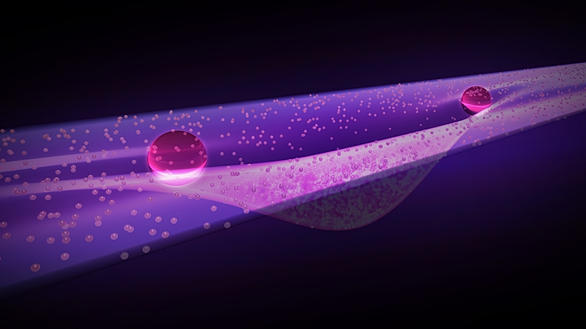
The quantum Hall effect, discovered in the early 1980s, is a phenomenon that was observed in a two-dimensional gas of electrons existing at the interface between two semiconductor layers. Subject to the severe criteria of very high material purity and very low temperatures, the electrons, when under the influence of a large magnetic field, will organize themselves into an ensemble state featuring remarkable properties.

Many physicists believe that quantum Hall physics is not unique to electrons, and thus it should be possible to observe this behavior elsewhere, such as in a collection of trapped ultracold atoms. Experiments at JQI and elsewhere are being planned to do just that. On the theoretical front, scientists* at JQI and University of Maryland have also made progress, which they describe in the journal Physical Review Letters. The result, to be summarized here, proposes using quantum matter made from a neutral atomic gas, instead of electrons. In this new design, elusive exotic states that are predicted to occur in certain quantum Hall systems should emerge. These states, known as parafermionic zero modes, may be useful in building robust quantum gates.

For electrons, the hallmark of quantum Hall behavior includes a free circulation of electrical charge around the edge but not in the interior of the sample. This research specifically relates to utilizing the fractional quantum Hall (FQH) effect, which is a many-body phenomenon. In this case, one should not consider just the movement of individual electrons, but rather imagine the collective action of all the electrons into particle-like “quasiparticles.” These entities appear to possess fractional charge, such as 1/3.

How does this relate to zero modes? Zero modes, as an attribute of quantum Hall systems, come into their own in the vicinity of specially tailored defects. Defects are where quasiparticles can be trapped. In previous works, physicists proposed that a superconducting nanowire serve as a defect that snags quasiparticles at either end of the wire. Perhaps the best-known example of a composite particle associated with zero-mode defects is the famed Majorana fermion.

Author David Clarke, a Postdoctoral Research Scholar from the UMD Condensed Matter Theory Center, explains, “Zero modes aren’t particles in the usual sense. They’re not even quasiparticles, but rather a place that a quasiparticle can go and not cost any energy.”

Aside from interest in them for studying fundamental physics, these zero modes might play an important role in quantum computing. This is related to what’s known as topology, which is a sort of global property that can allow for collective phenomena, such as the current of charge around the edge of the sample, to be impervious to the tiny microscopic details of a system. Here the topology endows the FQH system with multiple quantum states with exactly the same energy. The exactness and imperturbability of the energy amid imperfections in the environment makes the FQH system potentially useful for hosting quantum bits. The present report proposes a practical way to harness this predicted topological feature of the FQH system through the appearance of what are known as parafermionic zero-modes.

These strange and wonderful states, which in some ways go beyond Majoranas, first appeared on the scene only a few years ago, and have attracted significant attention. Now dubbed ‘parafermions,’ they were first proposed by Maissam Barkeshli and colleagues at Stanford University. Barkeshli is currently a postdoctoral researcher at Microsoft Station Q and will be coming soon to JQI as a Fellow. Author David Clarke was one of the early pioneers in studying how these states could emerge in a superconducting environment. Because both parafermions and Majoranas are expected to have unconventional behaviors when compared to the typical particles used as qubits, unambiguously observing and controlling them is an important research topic that spans different physics disciplines. From an application standpoint, parafermions are predicted to offer more versatility than Majorana modes when constructing quantum computing resources.

What this team does, for the first time, is to describe in detail how a parafermionic mode could be produced in a gas of cold bosonic atoms. Here the parafermion would appear at both ends of a one-dimensional trench of Bose-Einstein Condensate (BEC) atoms sitting amid a larger two-dimensional formation of cold atoms displaying FQH properties. According to first author and Postdoctoral Researcher Mohammad Maghrebi, “The BEC trench is the defect that does for atoms what the superconducting nanowire did for electrons.”

Some things are different for electrons and neutral atoms. For one thing, electrons undergo the FQH effect only if exposed to high magnetic fields. Neutral atoms have no charge and thus do not react strongly to magnetic fields; researchers must mimic this behavior by exposing the atoms to carefully designed laser pulses, which create a synthetic field environment. JQI Fellow Ian Spielman has led this area of experimental research and is currently performing atom-based studies of quantum Hall physics.

Another author of the PRL piece, JQI Fellow Alexey Gorshkov, explains how the new research paper came about: “Motivated by recent advances in Spielman's lab and (more recently) in other cold atom labs in generating synthetic fields for ultracold neutral atoms, we show how to implement in a cold-atom system the same exotic parafermionic zero modes proposed originally in the context of condensed-matter systems.”

“We argue that these zero modes, while arguably quite difficult to observe in the condensed matter context, can be observed quite naturally in atomic experiments,” says Maghrebi. “The JQI atmosphere of close collaboration and cross-fertilization between atomic physics and condensed matter physics on the one hand and between theory and experiment on the other hand was at the heart of this work.”

“Ultracold atoms play by a slightly different set of rules from the solid state,” says JQI Fellow Jay Sau. Things which come easy in one are hard in the other. Figuring out the twists in getting a solid state idea to work for cold atoms is always fun and the JQI is one of the best places to do it.”
(*)  The PRL paper has five authors, and their affiliations illustrate the complexity of modern physics work.  Mohammad Maghrebi, Sriram Ganeshan, Alexey Gorshkov, and Jay Sau are associated with the Joint Quantum Institute, operated by the University of Maryland and the National Institute for Standards and Technology.  Three of the authors---Ganeshan, Clarke, and Sau---are also associated with the Condensed Matter Theory Center at the University of Maryland physics department.  Finally, Maghrebi and Gorshkov are associated with the Joint Center for Quantum Information and Computer Science (usually abbreviated QuICS), which is, like the JQI, a University of Maryland-NIST joint venture.