Showing posts with label bionenergy. Show all posts

Wednesday, March 2, 2016

Researchers have created a model biological supercomputer that is both sustainable and highly energy efficient


The model bio-supercomputer is powered by adenosine triphosphate (ATP), the substance that provides energy to all of the cells in a human body. The model is able to process information extremely quickly and accurately using parallel networks, in the same fashion that electronic supercomputers are able to process information.

However, the bio-supercomputer developed by the project team is much smaller and more energy efficient than the current generation of electronic supercomputers, being only the size of a standard-sized book.

The model bio-supercomputer was created with a combination of geometrical modelling and engineering expertise on the nano-scale. Importantly, it is the first step in showing that a biological supercomputer could realistically work in practice.

Small, portable and energy efficient

The circuit created by the researchers is around 1.5 cm square and instead of electrons being propelled by an electrical charge, as is the case with a traditional microchip, short strings of proteins (called ‘biological agents’ by the project team) travel around the circuit in a controlled way. These movements are powered by ATP, a biochemical that enables internal energy transfer among cells.

Traditional supercomputers use a large amount of electricity and thus heat up to such high temperatures that they need to be physically cooled in order to function effectively. To do this, many supercomputers often require their own dedicated power plant.

In contrast, due to being run by biological agents, the bio-supercomputer hardly heats up at all and is consequently much more sustainable and cost-effective. As the technology is developed further over the coming years and possible routes to larger-scale commercialisation are considered, this could become a major selling-point.

Calculating answers to major societal issues

Although the model bio-supercomputer has successfully and efficiently tackled a complex mathematical problem by using parallel computing in the same fashion as traditional supercomputers, the project team recognises that there is still a long way to go between the model and the development of a full-scale functional bio-supercomputer.

It is hoped that an eventual shift to bio-supercomputers will provide solutions to the growing problem of traditional supercomputers being increasingly unable to quickly calculate answers to some of society’s most pressing issues, such as the development of new drugs and ensuring that engineering systems work as they are supposed to. For these problems, computers have to simply go through all of the possible guesses before reaching the correct answer. This means that if the problem size increases even modestly, the computer can no longer solve it quickly enough to be useful.

Next steps: From science fiction to science

The project team has already begun to explore other avenues on how to push their research even further, and hope that other scientists will be encouraged to also construct new models using alternative biological materials.

The eventual goal would be to perfect the design for a new generation of smaller, more portable and more energy efficient bio-supercomputers that can fully replace traditional supercomputers.

Although the research team believes that it will still take some time for this to become a reality, a potential mid-term solution would be to produce a hybrid design, mixing traditional and biological technologies.
 

ABACUS Project

Friday, March 28, 2014

Rainbow-catching waveguide could revolutionize energy technologies

The image shows a “multilayered waveguide taper array.”
The different wavelengths, or colors, are absorbed
by the waveguide tapers (thimble-shaped structures)
that together form an array.
By slowing and absorbing certain wavelengths of light, engineers open new possibilities in solar power, thermal energy recycling and stealth technology.

More efficient photovoltaic cells. Improved radar and stealth technology. A new way to recycle waste heat generated by machines into energy.

All may be possible due to breakthrough photonics research at the University at Buffalo.

The work, published March 28 in the journal Scientific Reports, explores the use of a nanoscale microchip component called a “multilayered waveguide taper array” that improves the chip’s ability to trap and absorb light.

Unlike current chips, the waveguide tapers (the thimble-shaped structures pictured above) slow and ultimately absorb each frequency of light at different places vertically to catch a “rainbow” of wavelengths, or broadband light.

The paper, “Broadband absorption engineering of hyperbolic metafilm patterns,” is here: http://bit.ly/1g72Is5.

“We previously predicted the multilayered waveguide tapers would more efficiently absorb light, and now we’ve proved it with these experiments,” says lead researcher Qiaoqiang Gan, PhD, UB assistant professor of electrical engineering. “This advancement could prove invaluable for thin-film solar technology, as well as recycling waste thermal energy that is a byproduct of industry and everyday electronic devices such as smartphones and laptops.”

Each multilayered waveguide taper is made of ultrathin layers of metal, semiconductors and/or insulators. The tapers absorb light in metal dielectric layer pairs, the so-called hyperbolic metamaterial. By adjusting the thickness of the layers and other geometric parameters, the tapers can be tuned to different frequencies including visible, near-infrared, mid-infrared, terahertz and microwaves.

The structure could lead to advancements in an array of fields.
For example, there is a relatively new field of advanced computing research called on-chip optical communication. In this field, there is a phenomenon known as crosstalk, in which an optical signal transmitted on one waveguide channel creates an undesired scattering or coupling effect on another waveguide channel. The multilayered waveguide taper structure array could potentially prevent this.

It could also improve thin-film photovoltaic cells, which are a promising because they are less expensive and more flexible that traditional solar cells. The drawback, however, is that they don’t absorb as much light as traditional cells. Because the multilayered waveguide taper structure array can efficiently absorb the visible spectrum, as well as the infrared spectrum, it could potentially boost the amount of energy that thin-film solar cells generate.
The multilayered waveguide taper array could help recycle waste heat generated by power plants and other industrial processes, as well as electronic devices such as televisions, smartphones and laptop computers.

“It could be useful as an ultra compact thermal-absorption, collection and liberation device in the mid-infrared spectrum,” says Dengxin Ji, a PhD student in Gan’s lab and first author of the paper.

It could even be used as a stealth, or cloaking, material for airplanes, ships and other vehicles to avoid radar, sonar, infrared and other forms of detection. “The multilayered waveguide tapers can be scaled up to tune the absorption band to a lower frequency domain and absorb microwaves efficiently,” says Haomin Song, another PhD student in Gan’s lab and the paper’s second author.

Additional authors of the paper include Haifeng Hu, Kai Liu, Xie Zeng and Nan Zhang, all PhD candidates in UB’s Department of Electrical Engineering.

The National Science Foundation sponsored the research.

Gan is a member of UB’s electrical engineering optics and photonics research group, which includes professors Alexander N. Cartwright (also UB vice president for research and economic development), Edward Furlani and Pao-Lo Liu; associate professor Natalia Litchinitser; and assistant professor Liang Feng.

The group carries out research in nanophotonics, biophotonics, hybrid inorganic/organic materials and devices, nonlinear and fiber optics, metamaterials, nanoplasmonics, optofluidics, microelectromechanical systems (MEMS), biomedical microelectromechanical systems (BioMEMs), biosensing and quantum information processing.

Source: http://www.buffalo.edu/news/releases/2014/03/049.html#sthash.9qx1DAsE.dpuf

Monday, March 3, 2014

Boosting Bioenergy

Computer simulations are revealing the biological barriers that prevent the conversion of biomass into energy.
A team led by Oak Ridge National Laboratory’s Jeremy Smith, the director of ORNL’s Center for Molecular Biophysics and a Governor’s Chair at the University of Tennessee, has uncovered information that could help others harvest energy from plant mass. The team’s conclusion—that less ordered cellulose fibers bind less lignin—was published in the August edition of Biomacromolecules.
The team used simulations on the Oak Ridge Leadership Computing Facility’s Jaguar supercomputer—a 2.3-petaflop machine that in 2012 morphed into Titan, which is a more than 27-petaflop supercomputer—along with neutron scattering to seek ways to make ethanol as cheap as gasoline at the pump.
“We are trying to figure out how to effectively break down plant materials like grass or wood chips cheaply enough to make biofuels economically viable,” said Loukas Petridis, a researcher in the Biosciences Division. “We are investigating the two main features that make biomass recalcitrant, or resistant to breakdown—the presence of lignin and the tightly ordered structure of cellulose.”

Lignin’s legacy

All plants contain a sticky molecule called lignin that intertwines with cellulose and hemicellulose in their cell walls. This substance is one of the major roadblocks preventing the cost-effective production of cellulosic ethanol.
Lignin is a plant cell’s first defense against man and beast. It provides strength to the stalks of plants so that these organisms can stand. But a plant’s best friend is a bioenergy researcher’s worst nightmare. During biofuel production—a process that converts plant mass into alcohol—lignin blocks enzymes from breaking down cellulose into the sugars necessary for fermentation.
Petridis works with ORNL’s Biofuels Science Focus Area, a multidisciplinary research group with experts in math, computer science, physics, chemistry, and biology who are working on the lignin problem. By studying lignin–cellulose and lignin–lignin interactions, the scientists have learned more about the physical processes that occur during biomass pretreatment, which is an expensive process that opens plant cell walls and helps enzymes break down plant mass.
“The process is very effective,” Petridis said. “Without it you wouldn’t be able to produce biofuels, but we want to improve it further so that the production of biofuels becomes cheaper and more efficient. In order to do this, we have to understand what is taking place during pretreatment on a molecular level.”

Combining the powers of neutrons and simulations

Neutron imaging and supercomputer simulation allow scientists to resolve the structure of lignin aggregates down to 1 angstrom, about 1 million times smaller than what the naked eye can see.
A previous simulation on Jaguar showed how different pretreatment temperatures change lignin’s structure, causing it to either aggregate or expand. Petridis’s study builds on this finding.
Using neutron beams at ORNL’s High Flux Isotope Reactor, researchers have discovered that cellulose fibers that are less organized, or noncrystalline, are easier for enzymes to break down. Simulations run on Jaguar helped explain this phenomenon.
“Jaguar has shown us that not only is noncrystalline cellulose more easily broken down, but it also associates less with lignin,” Petridis said. “This was the first simulation that has looked at the interaction of lignin with specific types of cellulose.”
But researchers often want to learn why a process is occurring on a more fundamental level. Fortunately computer models also reveal the reason behind lignin’s preference for crystalline cellulose.
“It is harder for lignin to associate with the noncrystalline cellulose because this cellulose interacts very strongly with water,” Petridis said. “To see this we needed Jaguar’s enormous supercomputing power to simulate 3 million lignin, cellulose, and water molecules.”
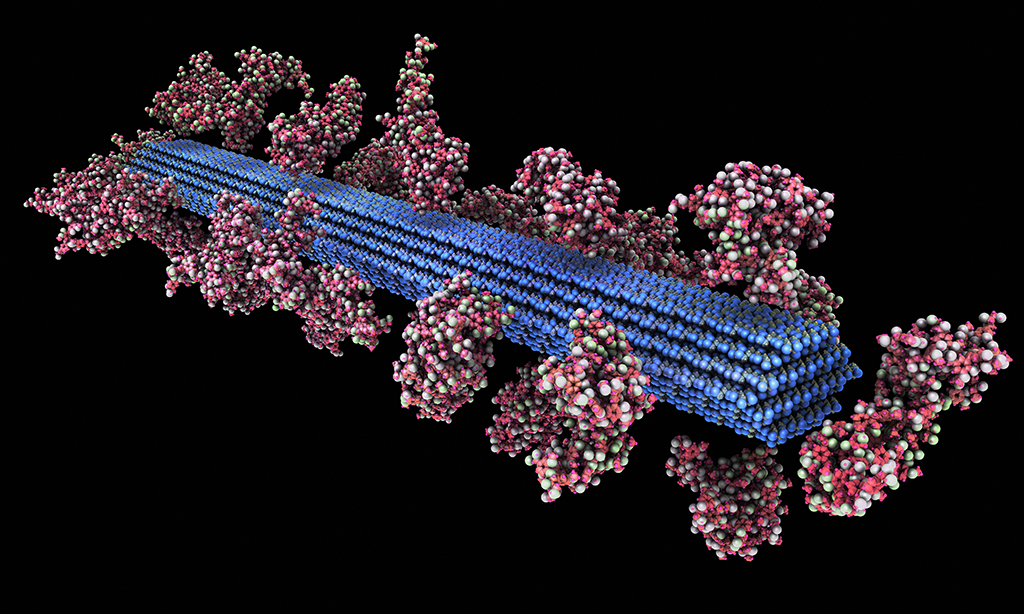
Interaction between cellulose fibril (blue) and lignin (pink) molecules. Visualization by Jamison Daniel (ORNL)

Accelerating scientific discovery

Smaller supercomputers can simulate a cellulose fiber and one lignin molecule, but they often miss many of the molecular interactions that ORNL supercomputers like Jaguar or Titan can capture.
Smith’s team was awarded 23 million processor hours on Jaguar in 2012 through the Innovative and Novel Computational Impact on Theory and Experiment, or INCITE, program.
Under the INCITE allocation, the team ran a classic molecular dynamics simulation with a code called GROMACS (for Groningen Machine for Chemical Simulations). The code monitored 3 million atoms and used 30,000 of Jaguar’s cores, which means that each core was responsible for 100 atoms. The application provides information on the interaction of water with the cellulose, degree of lignin aggregation, shapes of lignin molecules, diffusion constants, etc.
The researchers received another 78 million INCITE hours this year to run an adapted version of GROMACS that can take advantage of Titan’s speedy GPUs, making the updated application 10 times bigger and much faster than the one run on Jaguar.
The Titan supercomputer is capable of more than 27,000 trillion calculations per second, and is the fastest open-science supercomputer in America. OLCF’s hybrid machine includes CPUs and NVIDIA GPUs, which are computational accelerators originally found in gaming systems. The GPUs provide the processing power needed to simulate larger and more realistic systems and accelerate scientific discovery.
Current simulations track around 30 million atoms, which include crystalline and noncrystalline cellulose, lignin, enzymes and water molecules. The models also account for the long-range interactions that lignin molecules experience with other surrounding molecules. These interactions make the code especially difficult to scale because the processors have to exchange information very frequently to monitor the position of every atom every fraction of a second.
“If you compare our 3-million-atom simulation to our 30-million-atom simulation, you can guess that we’ll eventually be able to simulate a billion atoms, which is the size of a living cell,” said Smith. “Our simulations could even include the microbes that eat the biomass.”
The team is now studying how lignin behaves in different types of biomass, which will help the researchers identify the plant characteristics best suited for biofuel production.
“The scientific insights we gain help improve the biofuel production process,” Petridis said. “We give engineers hints about how the production process works, which we hope will allow them to design new pretreatment methods and engineer different types of biomass and enzymes that can harvest more energy from plant materials.”

Bigger, faster supercomputers

As supercomputing power increases, Petridis’s team will be able to simulate longer biological processes in greater detail. The simulations they run are already high resolution, but they can simulate only processes that happen within milliseconds.

“We can simulate lignin aggregation because it takes place in a millisecond, but there are other interesting biological processes that take much longer than 1 millisecond,” Petridis said. “The future of supercomputing is being able to access time and length scales that are currently accessible only through neutron scattering experiments.” —Jennifer Brouner
Source: https://www.olcf.ornl.gov/2014/01/02/boosting-bioenergy/