Showing posts with label biomolecules. Show all posts

Monday, September 28, 2015

Chip-based technology enables reliable direct detection of Ebola virus

This hybrid device integrates a microfluidic chip for sample preparation and an optofluidic chip for optical detection of individual molecules of viral RNA. (Photo by Joshua Parks)

A team led by researchers at UC Santa Cruz has developed chip-based technology for reliable detection of Ebola virus and other viral pathogens. The system uses direct optical detection of viral molecules and can be integrated into a simple, portable instrument for use in field situations where rapid, accurate detection of Ebola infections is needed to control outbreaks.
Laboratory tests using preparations of Ebola virus and other hemorrhagic fever viruses showed that the system has the sensitivity and specificity needed to provide a viable clinical assay. The team reported their results in a paper published September 25 in Nature Scientific Reports.
An outbreak of Ebola virus in West Africa has killed more than 11,000 people since 2014, with new cases occurring recently in Guinea and Sierra Leone. The current gold standard for Ebola virus detection relies on a method called polymerase chain reaction (PCR) to amplify the virus's genetic material for detection. Because PCR works on DNA molecules and Ebola is an RNA virus, the reverse transcriptase enzyme is used to make DNA copies of the viral RNA prior to PCR amplification and detection.

"Compared to our system, PCR detection is more complex and requires a laboratory setting," said senior author Holger Schmidt, the Kapany Professor of Optoelectronics at UC Santa Cruz. "We're detecting the nucleic acids directly, and we achieve a comparable limit of detection to PCR and excellent specificity."
Sensitivity and specificity
In laboratory tests, the system provided sensitive detection of Ebola virus while giving no positive counts in tests with two related viruses, Sudan virus and Marburg virus. Testing with different concentrations of Ebola virus demonstrated accurate quantification of the virus over six orders of magnitude. Adding a "preconcentration" step during sample processing on the microfluidic chip extended the limit of detection well beyond that achieved by other chip-based approaches, covering a range comparable to PCR analysis.
"The measurements were taken at clinical concentrations covering the entire range of what would be seen in an infected person," Schmidt said.
Schmidt's lab at UC Santa Cruz worked with researchers at Brigham Young University and UC Berkeley to develop the system. Virologists at Texas Biomedical Research Institute in San Antonio prepared the viral samples for testing.
The system combines two small chips, a microfluidic chip for sample preparation and an optofluidic chip for optical detection. For over a decade, Schmidt and his collaborators have been developing optofluidic chip technology for optical analysis of single molecules as they pass through a tiny fluid-filled channel on the chip. The microfluidic chip for sample processing can be integrated as a second layer next to or on top of the optofluidic chip.
Sample preparation
Schmidt's lab designed and built the microfluidic chip in collaboration with coauthor Richard Mathies at UC Berkeley who pioneered this technology. It is made of a silicon-based polymer, polydimethylsiloxane (PDMS), and has microvalves and fluidic channels to transport the sample between nodes for various sample preparation steps. The targeted molecules--in this case, Ebola virus RNA--are isolated by binding to a matching sequence of synthetic DNA (called an oligonucleotide) attached to magnetic microbeads. The microbeads are collected with a magnet, nontarget biomolecules are washed off, and the bound targets are then released by heating, labeled with fluorescent markers, and transferred to the optofluidic chip for optical detection.
Schmidt noted that the team has not yet been able to test the system starting with raw blood samples. That will require additional sample preparation steps, and it will also have to be done in a biosafety level 4 facility.

"We are now building a prototype to bring to the Texas facility so that we can start with a blood sample and do a complete front-to-back analysis," Schmidt said. "We are also working to use the same system for detecting less dangerous pathogens and do the complete analysis here at UC Santa Cruz."
The lead authors of the paper are postdoctoral researcher Hong Cai and graduate student Joshua Parks, both in Schmidt's lab at UC Santa Cruz. A team led by Aaron Hawkins at BYU fabricated the silicon-based optofluidic chips. Virologist Jean Patterson led the team at Texas Biomedical Research Institute that prepared viral samples for testing. This research was supported by the W. M. Keck Center for Nanoscale Optofluidics at UC Santa Cruz and grants from the National Institutes of Health and the National Science Foundation.

Monday, April 28, 2014

Resolving the structure of a single biological molecule

An image of the DNA double helix structure taken with the AFM, with the Watson-Crick DNA structure overlaid (purple and blue).

Researchers at the London Centre for Nanotechnology have determined the structure of DNA from measurements on a single molecule, and found that this structure is not as regular as one might think, reports the journal Small.
Our life depends on molecular machinery that is continuously at work in our bodies. The structure of these nanometre-scale machines is thus at the heart of our understanding of health and disease. This is very apparent in the case of the Watson-Crick DNA double-helix structure, which has been the key to understanding how genetic information is stored and passed on.
Watson and Crick’s discovery was based on diffraction of X-rays by millions of ordered and aligned DNA molecules. This method is extremely powerful and still used today – in a more evolved form – to determine the structure of biological molecules. It has the important drawbacks, however, that it only provides static, averaged pictures of molecular structures and that it relies on the accurate ordering and alignment of many molecules. This process, called crystallisation, can prove very challenging.
Building on previous work in Dr Bart Hoogenboom’s research group at the London Centre for Nanotechnology, and in collaboration with the National Physical Laboratory, first author Alice Pyne has applied “soft-touch” atomic force microscopy to large, irregularly arranged and individual DNA molecules. In this form of microscopy, a miniature probe is used to feel the surface of the molecules one by one, rather than seeing them.
To demonstrate the power of their method, Pyne, Hoogenboom and collaborators have measured the structure of a single DNA molecule, finding on average good agreement with the structure as it has been known since Watson and Crick. Strikingly, however, the single-molecule images also reveal significant variations in the depths of grooves in the double helix structure.
While the origin of the observed variations is not yet fully understood, it is known that these grooves act as keyways for proteins (molecular keys) that determine to which extent a gene is expressed in a living cell. The observation of variations in these keyways may thus help us to determine the mechanisms by which living cells promote and suppress the use of genetic information stored in their DNA.
Source: https://www.london-nano.com/research-and-facilities/highlight/resolving-the-structure-of-a-single-biological-molecule

Wednesday, January 29, 2014

'Chameleon of the sea' reveals its secrets

Sophisticated biomolecular nanophotonic system underlying the cuttlefish’s color-changing ways


CUTTLEFISH MAY OFFER MODEL FOR BIOINSPIRED HUMAN CAMOUFLAGE AND COLOR-CHANGING PRODUCTS
Scientists at Harvard University and the Marine Biological Laboratory (MBL) hope new understanding of the natural nanoscale photonic device that enables a small marine animal to dynamically change its colors will inspire improved protective camouflage for soldiers on the battlefield.
The cuttlefish, known as the "chameleon of the sea," can rapidly alter both the color and pattern of its skin, helping it blend in with its surroundings and avoid predators. In a paper published January 29 in the Journal of the Royal Society Interface, the Harvard-MBL team reports new details on the sophisticated biomolecular nanophotonic system underlying the cuttlefish’s color-changing ways.
"Nature solved the riddle of adaptive camouflage a long time ago," said Kevin Kit Parker, Tarr Family Professor of Bioengineering and Applied Physics at the Harvard School of Engineering and Applied Sciences (SEAS) and core faculty member at the Wyss Institute for Biologically Inspired Engineering at Harvard. “Now the challenge is to reverse-engineer this system in a cost-efficient, synthetic system that is amenable to mass manufacturing."
In addition to textiles for military camouflage, the findings could also have applications in materials for paints, cosmetics, and consumer electronics.
The cuttlefish (Sepia officinalis) is a cephalopod, like squid and octopuses. Neurally controlled, pigmented organs called chromatophores allow it to change its appearance in response to visual clues, but scientists have had an incomplete understanding of the biological, chemical, and optical functions that make this adaptive coloration possible.
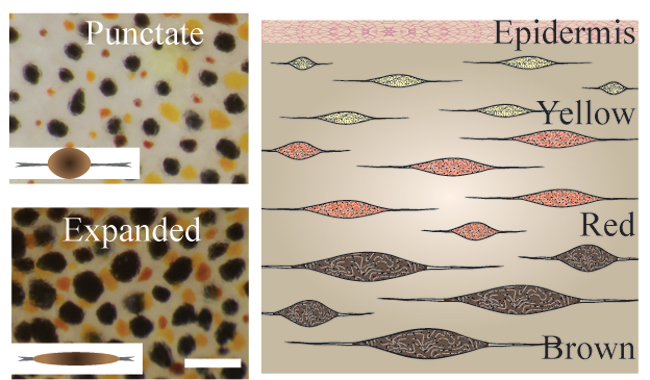
Cuttlefish chromatophores
Left: Cuttlefish chromatophores change from a punctuate to expanded state in response to visual cues. The scale bar measures one millimeter. Right: This illustrated cross-section of the skin shows the layering of three types of chromatophores. Iridophores and leucophores would be positioned beneath the chromatophores. (Images courtesy of Lydia Mathger.)

To regulate its color, the cuttlefish relies on a vertically arranged assembly of three optical components: the leucophore, a near-perfect light scatterer that reflects light uniformly over the entire visible spectrum; the iridophore, a reflector comprising a stack of thin films; and the chromatophore. This layering enables the skin of the animal to selectively absorb or reflect light of different colors, said coauthor Leila F. Deravi, a research associate in bioengineering at Harvard SEAS.
"Chromatophores were previously considered to be pigmentary organs that acted simply as selective color filters,” Deravi said. “But our results suggest that they play a more complex role; they contain luminescent protein nanostructures that enable the cuttlefish to make quick and elaborate changes in its skin pigmentation."
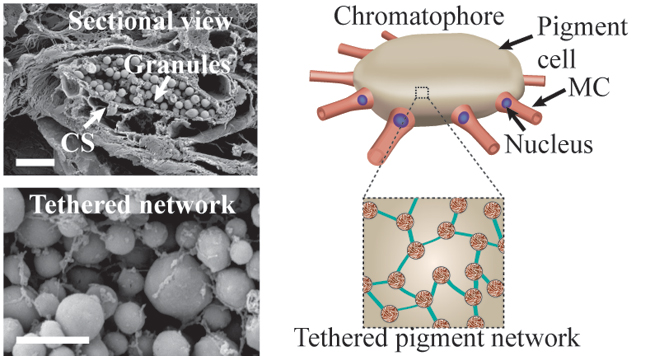
When the cuttlefish actuates its coloration system, each chromatophore expands; the surface area can change as much as 500 percent. The Harvard-MBL team showed that within the chromatophore, tethered pigment granules regulate light through absorbance, reflection, and fluorescence, in effect functioning as nanoscale photonic elements, even as the chromatophore changes in size.
Chromatophore structure
Chromatophores were previously thought to be simply sacs of pigment that acted as filters; scientists have now discovered that nanostructures (labeled here as "granules") within the cells are capable of fluorescing. (Images courtesy of George Bell.)

"The cuttlefish uses an ingenious approach to materials composition and structure, one that we have never employed in our engineered displays," said coauthor Evelyn Hu, Tarr-Coyne Professor of Applied Physics and of Electrical Engineering at SEAS. "It is extremely challenging for us to replicate the mechanisms that the cuttlefish uses. For example, we cannot yet engineer materials that have the elasticity to expand 500 times in surface area. And were we able to do so, the richness of color of the expanded and unexpanded material would be dramatically different—think of stretching and shrinking a balloon. The cuttlefish may have found a way to compensate for this change in richness of color by being an 'active' light emitter (fluorescent), not simply modulating light through passive reflection."
The team also included Roger Hanlon and his colleagues at the Marine Biological Laboratory in Woods Hole, Mass. Hanlon’s lab has examined adaptive coloration in the cuttlefish and other invertebrates for many years.
"Cuttlefish skin is unique for its dynamic patterning and speed of change," Hanlon said. "Deciphering the relative roles of pigments and reflectors in soft, flexible skin is a key step to translating the principles of actuation to materials science and engineering. This collaborative project expanded our breadth of inquiry and uncovered several useful surprises, such as the tether system that connects the individual pigment granules."
For Parker, an Army reservist who completed two tours of duty in Afghanistan, using the cuttlefish to find a biologically inspired design for new types of military camouflage is more than an academic pursuit. He understands first-hand that poor camouflage patterns can cost lives on the battlefield.
"Throughout history, people have dreamed of having an 'invisible suit,'" Parker said. "Nature solved that problem, and now it’s up to us to replicate this genius so, like the cuttlefish, we can avoid our predators."
In addition to Parker, Hu, Hanlon, and Deravi, the coauthors of the Interface paper are: Andrew P. Magyar, a former postdoctoral student in Hu’s group; Sean P. Sheehy, a graduate student in Parker’s group; and George R. R. Bell, Lydia M. Mäthger, Stephen L. Senft, Trevor J. Wardill, and Alan M. Kuzirian, who all work with Hanlon in the Program in Sensory Physiology and Behavior at the Marine Biological Laboratory.
This work was supported in part by the Defense Advanced Research Projects Agency, the Nanoscale Science and Engineering Center at Harvard supported by the National Science Foundation (NSF), the NSF-supported Harvard Materials Research Science and Engineering Center, and the Air Force Office of Scientific Research.

Source: https://www.seas.harvard.edu/news/2014/01/chameleon-of-sea-reveals-its-secrets

Thursday, November 21, 2013

Before Cells, Biochemicals May Have Combined in Clay

Clay – an assortment of silicates leached from
rock by weathering, is made up of tiny disks a
few nanometers (billionths of a meter) across,
as seen in an electron microscope photo, above.
The disks have negative charges on the flat
surface and positive charges around the rim.
Herded by charged ions in sea water the disks
join in a “house of cards” structure that makes
 a spongy mass.
Clay – a seemingly infertile blend of minerals – might have been the birthplace of life on Earth. Or at least of the complex biochemicals that make life possible, Cornell University biological engineers report in the Nov. 7 online issue of the journal Scientific Reports, published by Nature Publishing.
“We propose that [in early geological history] clay hydrogel provided a confinement function for biomolecules and biochemical reactions,” said Dan Luo, professor of biological and environmental engineering and a member of the Kavli Institute at Cornell for Nanoscale Science.
In simulated ancient seawater, clay forms a hydrogel – a mass of microscopic spaces capable of soaking up liquids like a sponge. Over billions of years, Luo explained, chemicals confined in those spaces could have carried out the complex reactions that formed proteins, DNA and eventually all the machinery that makes a living cell work. Clay hydrogels could have confined and protected those chemical processes until the membrane that surrounds living cells developed, he said.

The Luo group previously has used synthetic hydrogels as a “cell-free” medium for protein production. Fill the spongy material with DNA, amino acids, the right enzymes and a few bits of cellular machinery and you can make the proteins for which the DNA encodes, just as you might in a vat of cells. To make the process useful for producing large quantities of proteins, such as for drug manufacturing, you need a lot of hydrogel, so the researchers set out to find a cheaper way to make it. Postdoctoral researcher Dayong Yang noticed that clay formed a hydrogel. Why consider clay? “It’s dirt cheap,” said Luo. Better yet, it turned out unexpectedly that using clay enhanced protein production.
But then it occurred to the researchers that what they had discovered might answer a long-standing question about how biomolecules evolved. Experiments by the late Carl Sagan of Cornell and others have shown that amino acids and other biomolecules could have been formed in primordial oceans, drawing energy from lightning or volcanic vents. But in the vast ocean, how could these molecules come together often enough to assemble into more complex structures, and what protected them from the harsh environment? Scientists previously suggested that tiny balloons of fat or polymers might have served as precursors of cell membranes. Clay is a promising possibility because biomolecules tend to attach to its surface, and theorists have shown that cytoplasm – the interior environment of a cell – behaves much like a hydrogel. And, Luo said, a clay hydrogel better protects its contents from damaging enzymes (called “nucleases”) that might dismantle DNA and other biomolecules.
As further evidence, geological history shows that clay first appeared – as silicates leached from rocks – just at the time biomolecules began to form into protocells – cell-like structures, but incomplete – and eventually membrane-enclosed cells. The geological events matched nicely with biological events.
How these biological machines evolved remains to be explained, Luo said. For now his research group is working to understand why a clay hydrogel works so well, with an eye to practical applications in cell-free protein production.
Luo collaborated with Max Lu, a professor at the Australian Institute for Bioengineering and Nanotechnology at the University of Queensland in Australia. The work was performed at the Cornell Center for Materials Research Shared Facilities, supported by the National Science Foundation.


Friday, November 8, 2013

Build-A-Nanoparticle

An engineered Silicon-Silver nanoparticle of ~10 nanometers in size.
Image: OIST
Nanoparticles, which range from 1-100 nanometers in size, are roughly the same size as biomolecules such as proteins, antibodies, and membrane receptors.  Because of this size similarity, nanoparticles can mimic biomolecules and therefore have a huge potential for application in the biomedical field. In a paper published in Scientific Reports on October 30th, a group of researchers from the OIST Nanoparticles by Design Unit lead by Prof. Mukhles Sowwan announced that they have succeeded in designing and creating multicomponent nanoparticles with controlled shape and structure.
Multicomponent nanoparticles, which are nanoparticles containing two or more materials, are even more powerful since they bring together the unique properties of each material to make a single nanoparticle with various functionalities. For example, a single-component nanoparticle may be able to transport drugs but may not be able to differentiate between healthy and diseased cells. In contrast, a multicomponent nanoparticle could also include characteristics of another material that can distinguish between healthy and diseased cells to make drug delivery more efficient.
The OIST researchers produced Silicon-Silver nanoparticles using advanced equipment custom-designed specifically for producing multicomponent nanoparticles. Silicon and Silver are an interesting combination because each element has different optical properties that give out different signals. A single nanoparticle simultaneously sending out multiple signals is attractive for bioimaging and biosensoring: for example, Silver would show whether a certain reaction is happening or not, while Silicon could give out information about where the nanoparticles are located.
Especially exciting is that Prof. Sowwan and his team that includes scientists from Ireland, Greece, India, United Kingdom, Peru, South Korea, Palestine, France, Spain, and Japan, can customize not only the shape and structure of the nanoparticles but also the nanoparticles’ characteristics. Engineering a particle that is 10 million times smaller than the size of a football is not easy: although nanoparticles like these have been made elsewhere in the past using different methods, they lack the level of control and purity offered at the Nanoparticles by Design Unit. With this technique, the size, structure, and  crystallinity – the orderliness of atoms –  of each nanoparticle can be customized. In this particular study, Sliver was used to control the crystallinity of Silicon. By controlling the crystallinity, optical, electrical, and chemical properties of the nanoparticle can be fine-tuned. “This is engineering. We control how we want the nanoparticles to be,” said Prof. Sowwan.